
meet the... Khala
Both Central and South America are renowned for their many hairless dogs, and these dogs are believed to be descendants of the same ancestral dogs owned by the Incan Empire. The Peruvian Inca Orchid and the Khala are ancient and fairly rare breeds that are believed to have arrived in various places along with their ancient people. The Incan and Moche native peoples’ empire was vast, reaching from the north Andes throughout modern-day Peru, Bolivia, Ecuador, and parts of the south of Columbia through the Chilean and Argentinean mountains. Artifacts depicting these dogs in ceremonial dress have been dated to these tribes as far back as 2,000 years ago, likely making them some of the first domesticated dogs in the Americas. Throughout this region, the Quechua people would trade or gift their “khala” (Quechua for “naked”) dogs in exchange for goods, services, or to build community. These dogs were historically used for food, sentries, companionship, religious purposes, and as bed warmers. Coated varieties were permitted outside throughout the day, where they suffered no fear of sunburn, unlike the coated variety. Also, the Inca seemed to prefer the spotted dogs over the solid dogs, with the solid dogs being used more for outdoor work or food and the spotted dogs being kept more for companion purposes. When the Spanish invaded and conquered the Incas, they noted that these dogs were often found sleeping among orchids and other flowers and were therefore referred to by the Spanish as Perros Flora, or “flower dogs.” The Spanish conquest destroyed much of the Incan culture and networks, including their trade routes. For many centuries, native people remained isolated from one another. During this period of isolation, the native hairless dogs naturally developed into their own landraces, resulting in the breeds we see today. The Khala, also known as the Peruvian Inca Hairless Dog, the Peruvian Inca Orchid, is the spotted variety of the Peruvian Hairless Dog and the Argentinian Pila Dog. The breed was never appreciated by the Spanish, who considered them mongrels. However, they remained relatively popular in their home countries throughout Patagonia and South America. They experienced a brief state of national appreciation at the turn of the 20th century. However, they were quickly displaced from the spotlight when the purebred fancy spread to South America, and they were dethroned by other, more exotic dogs. Their status then fell back to lowly pariah or village dog, and they were not often kept for much more than those purposes. However, in recent years, efforts have been made to save and popularize the pre-Columbian breeds of Central and South America.
View Full Breed Standard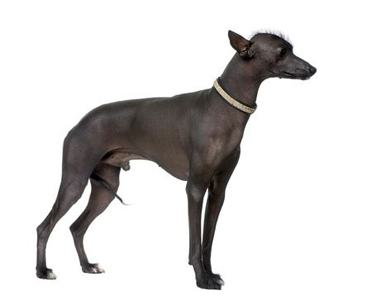
Both Central and South America are renowned for their many hairless dogs, and these dogs are believed to be descendants of the same ancestral dogs owned by the Incan Empire. The Peruvian Inca Orchid and the Khala are ancient and fairly rare breeds that are believed to have arrived in various places along with their ancient people. The Incan and Moche native peoples’ empire was vast, reaching from the north Andes throughout modern-day Peru, Bolivia, Ecuador, and parts of the south of Columbia through the Chilean and Argentinean mountains. Artifacts depicting these dogs in ceremonial dress have been dated to these tribes as far back as 2,000 years ago, likely making them some of the first domesticated dogs in the Americas. Throughout this region, the Quechua people would trade or gift their “khala” (Quechua for “naked”) dogs in exchange for goods, services, or to build community. These dogs were historically used for food, sentries, companionship, religious purposes, and as bed warmers. Coated varieties were permitted outside throughout the day, where they suffered no fear of sunburn, unlike the coated variety. Also, the Inca seemed to prefer the spotted dogs over the solid dogs, with the solid dogs being used more for outdoor work or food and the spotted dogs being kept more for companion purposes. When the Spanish invaded and conquered the Incas, they noted that these dogs were often found sleeping among orchids and other flowers and were therefore referred to by the Spanish as Perros Flora, or “flower dogs.” The Spanish conquest destroyed much of the Incan culture and networks, including their trade routes. For many centuries, native people remained isolated from one another. During this period of isolation, the native hairless dogs naturally developed into their own landraces, resulting in the breeds we see today. The Khala, also known as the Peruvian Inca Hairless Dog, the Peruvian Inca Orchid, is the spotted variety of the Peruvian Hairless Dog and the Argentinian Pila Dog. The breed was never appreciated by the Spanish, who considered them mongrels. However, they remained relatively popular in their home countries throughout Patagonia and South America. They experienced a brief state of national appreciation at the turn of the 20th century. However, they were quickly displaced from the spotlight when the purebred fancy spread to South America, and they were dethroned by other, more exotic dogs. Their status then fell back to lowly pariah or village dog, and they were not often kept for much more than those purposes. However, in recent years, efforts have been made to save and popularize the pre-Columbian breeds of Central and South America.
View Full Breed Standard
 Quick Facts

Group
Primitive, Pariah, and Feral Breeds

Life Expectancy
10 - 14 years

Coat Type
Hairy hairless, Naked hairless, Tufted hairless, Close coat, Flat coat

Origin
SOUTH AMERICA/CENTRAL AMERICA

Weight
26-55 lbs 26-55 lbs

Height
19-26 in 18-26 in
 Breed Ratings
How They Compare
Breed Ratings
How They Compare

 Breed History
Tails of Time
Breed History
Tails of Time
Both Central and South America are renowned for their many hairless dogs, and these dogs are believed to be descendants of the same ancestral dogs owned by the Incan Empire. The Peruvian Inca Orchid and the Khala are ancient and fairly rare breeds that are believed to have arrived in various places along with their ancient people. The Incan and Moche native peoples’ empire was vast, reaching from the north Andes throughout modern-day Peru, Bolivia, Ecuador, and parts of the south of Columbia through the Chilean and Argentinean mountains. Artifacts depicting these dogs in ceremonial dress have been dated to these tribes as far back as 2,000 years ago, likely making them some of the first domesticated dogs in the Americas. Throughout this region, the Quechua people would trade or gift their “khala” (Quechua for “naked”) dogs in exchange for goods, services, or to build community.
These dogs were historically used for food, sentries, companionship, religious purposes, and as bed warmers. Coated varieties were permitted outside throughout the day, where they suffered no fear of sunburn, unlike the coated variety. Also, the Inca seemed to prefer the spotted dogs over the solid dogs, with the solid dogs being used more for outdoor work or food and the spotted dogs being kept more for companion purposes.
When the Spanish invaded and conquered the Incas, they noted that these dogs were often found sleeping among orchids and other flowers and were therefore referred to by the Spanish as Perros Flora, or “flower dogs.” The Spanish conquest destroyed much of the Incan culture and networks, including their trade routes. For many centuries, native people remained isolated from one another. During this period of isolation, the native hairless dogs naturally developed into their own landraces, resulting in the breeds we see today. The Khala, also known as the Peruvian Inca Hairless Dog, the Peruvian Inca Orchid, is the spotted variety of the Peruvian Hairless Dog and the Argentinian Pila Dog.
The breed was never appreciated by the Spanish, who considered them mongrels. However, they remained relatively popular in their home countries throughout Patagonia and South America. They experienced a brief state of national appreciation at the turn of the 20th century. However, they were quickly displaced from the spotlight when the purebred fancy spread to South America, and they were dethroned by other, more exotic dogs. Their status then fell back to lowly pariah or village dog, and they were not often kept for much more than those purposes. However, in recent years, efforts have been made to save and popularize the pre-Columbian breeds of Central and South America.
 Breed Standard
Official CKC Standards
Breed Standard
Official CKC Standards
Khala
Breed Group 1: Primitive, Pariah, and Feral Breeds
Breed Name Aliases
Peruvian Hairless Dog, Inca Hairless Dog, Inca Dog, Hairless Khala, Khala Dog, Argentine Pila Dog
Proportions:
Off-square to slightly rectangular, with the length of the body measured from the point of the forechest to the point of the rump, being just slightly greater than the height at the withers. Females tend to be slightly longer than males in body length. The length-to-height ratio is between 5:4 and 10:9. The body is well-put-together, with sturdy substance and medium bone. The weight of males or females is always in proportion to height.
Continental Kennel Club (CKC) recognizes three size varieties of the Khala dogs:
Large
HEIGHT: 19-26 inches
WEIGHT: 26-55 pounds
Medium
HEIGHT: 15-20 inches
WEIGHT: 17-27 pounds
Small
HEIGHT: 9-16 inches
WEIGHT: 9-18 pounds
Head
- General Appearance: Mesaticephalic skull type, moderate in size, and wedge-shaped with a broad back of the skull that tapers toward the muzzle and in proportion to the rest of the body. The topskull is broad and may be just slightly arched or flat when viewed from the front or in profile. The occiput is not well-defined. The head is clean-cut; however, slight wrinkling may be evident on hairless dogs, although neither variety should exhibit loose or pendulous skin or excessive wrinkling.
- Expression: Lively, intelligent, watchful, and approachable.
- Stop: The stop is slight to somewhat well-defined. It should never appear overly pronounced or smooth.
-
Skull:
The ideal muzzle-to-skull ratio is 1:1 to 4:5, with the topskull being equal to the muzzle or just slightly shorter.
The ideal muzzle-to-skull axis is parallel or may be just slightly convergent. - Muzzle: The muzzle is full and broad. The plane, or bridge of the muzzle, is straight. It tapers from the broad base toward the nose, giving the head the characteristic wedge shape. The upper and lower jaws are well-developed, approximately equal in length, and have good bone substance, never appearing snipey or weak.
- Lips or Flews: The lips are clean and fit tightly over the teeth and jaws.
- Nose: The nose is well-pigmented according to the coat. The nostrils are well-opened. Butterfly noses are permissible but should be mostly pigmented.
- Cheeks: The cheeks are well-developed and well-muscled. They should never appear flat or chiseled.
- Dentition and Bite: Forty-two strong, clean, and white teeth. The bite may be level, scissor, or reverse-scissor. Contact must be made between the top and bottom incisors. Missing or broken teeth due to routine work are not to be penalized. The tongue must never be visible when the mouth is shut.
- Eyes: Moderate in size, oval to almond in shape, and hazel, amber, to dark brown in color. The eye rims are well-fitted and well-pigmented. The eyes are never bulging. There should be sufficient bone in the surrounding orbital sockets to protect the eyes. Any signs of entropion or ectropion are incorrect for this breed.
- Ears: Medium to fairly large in size, somewhat elongated, and firmly erect by one year of age. The ears are set fairly high on the skull. They have rounded tips. The ears are always natural and never surgically cropped or broken.
Body and Tail
- General Description: Compact, deep, solid, and of good substance. The body is elegant but never racy or refined. The width at the forequarters is approximately equal to the width at the hindquarters.
- Neck: Moderately long to allow for proud head carriage and powerfully muscled with a slight arch. The neck tapers smoothly from the deeper and broader body toward the head. The neck is clean-cut and without excess skin, throatiness, or dewlap.
- Chest: Deep and broad but never wider than deep. The brisket extends to the point of the elbows.
- Topline: Level from slightly prominent withers to croup. The back is broad, strongly muscled, and straight, yet supple. The loin is taut and may be flat, level, or slightly arched yet supportive. The back is never swayed or roached.
- Croup: Broad and gently sloped.
- Underline: A slight to moderate tuck-up is present. The underline is taut and firm, without any indication of sagging or excess weight.
- Ribs: Long, well-sprung, well-laid-back, and oval-shaped, never barrel-chested or slab-sided.
- Tail: Set somewhat low or neither high nor low on the croup but as a natural extension of the topline. It is thicker at the base and tapering toward the tip. The tail is carried in accordance with the dog’s mood and energy level, usually upward in a curve but never tucked. The tail is fairly long, with the tip of the last vertebrae extending to the hock joints when held down. The tail may be straight, sickled, sabered, or gently curved.
Forequarters and Hindquarters
- Forequarters: The forequarters are always balanced with the hindquarters and well-angulated with well-laid-back shoulder blades. The shoulder blades are long and approximately equal in length to the upper arm and forearm.
- Elbows: The elbows are close to the body. The distance from the withers to the brisket may be equal to or slightly less than the distance from the elbows to the ground.
-
Forelegs:
Frontal View: Straight, of good muscle, of moderate bone, and parallel to one another.
Side View: The forelimbs appear straight with strong pasterns. - Pasterns: Never weak or broken.
-
Hindquarters:
The upper and lower thighs are long, equal in length, strong, sturdy, of moderate bone, and well-muscled.
Rear View: When viewed from the rear, the rear pasterns are parallel to one another.
Side View: Good angulation will allow the rear toes to align with the point of the rump or within one to two paw-lengths behind the point of the rump, with the rear pasterns remaining perpendicular to the ground and parallel to one another. - Stifle Joint: Well-angulated with a good bend to well-let-down rear pasterns.
- Stifle Joint: The angulation of the hindquarters is always in balance with the angulation of the forequarters.
- Feet: Oval, round, or hare-like, compact, with well-arched toes and tough pads. Dewclaws may be present on all four limbs.
Coat
- Skin: Well-fitted, yet supple. The skin should never obstruct the outline of the dog. The natural wrinkling of a dog’s skin will be evident in the hairless variety; however, the skin should never appear pendulous or excessive.
-
Coat Type:
The Khala breed comes in two coat varieties: the coated and the hairless.
The coated variety comes in two coat lengths:
*Short coat: A complete short and close coat. The coat is short and smooth. The texture may be soft or slightly harsh to the touch and glossy. It may be uniform in length throughout, with or without undercoat. If an undercoat is present, it will be just slightly longer on the neck—forming a light ruff—and on the tail. No fringe or feather is permissible.
*Medium coat: The coat is short on the face, forehead, and front of the forelimbs and hindlimbs. The coat is flat and medium length on the neck, ears, rear of the forelimbs and hindlimbs, feet, and tail, forming well-developed fringe and furnishings. Undercoats may or may not be present. The coat should never be abundantly thick, abundantly long, or silky.
Hairless variety: The coat may be completely absent of hair or with small amounts of hair—or “tufts”—on the head, back of the neck, ears, lower legs, feet, and tail. The hair may range from short to medium in length. Extra care must be given to the skin of these dogs, as it is at the mercy of the elements and climate without a protective coat. - Coat Color or Pattern: Various shades and tones of black, slate, blue, gray, dark brown, red, pink, blonde, bronze, tan, white, chocolate, gold, mahogany, ruby, tan, and apricot, all with or without varying degrees of white markings.
Movement
Free, elastic, effortless, efficient, and with good energy, the characteristics of a healthy structure are evident. When moving away, the forelegs and rear pasterns should remain parallel to one another. When viewing movement from the front, the forelegs should remain parallel, with elbows and paws moving neither in nor out. From the rear, the back pads should be visible when the rear legs are extended. As speed increases, the forelimbs and hindlimbs will converge to the centerline of gravity. From the side, the topline should remain firm and level. Good reach of movement in the front allows the forepaw to extend out in line with the nose. When extended, the width between the forefeet should be approximately equal to the width between the hindfeet when extended, indicating balance, good reach, and good drive. Dogs that exhibit any sign of breathing or locomotive difficulty shall be disqualified from the show ring.
Temperament
The Khala breed is known to be even-tempered, calm, friendly, and somewhat aloof toward strangers. Around people they are comfortable with, Khalas are attentive, friendly, loyal, affectionate, and cheerful. Their wariness around strangers makes them ideal watchdogs. They are also intelligent and easily trained with the right motivation and encouragement, making them excellent family companions. Any unprovoked aggressive or fearful behavior toward people is incorrect for this breed.
Faults
All dogs should be in proper healthy condition, free from disease or defect. Any departure from this description is considered a fault. Unless altered, all male dogs should have two fully descended testicles.

Take our Dog Breed Match Quiz!
What is the best dog breed for you? Take our quiz!