
meet the... Cairn Terrier
The Cairn Terrier shares a history with Skye Terriers, West Highland White Terriers, and Scottish Terriers. Evidence of these rough-coated terriers has been recorded in Scotland for centuries. Originally, these terriers were used to eradicate vermin and hunt foxes and badgers. The Hebrides archipelago north of Scotland was well-known for the rich cultural history of its islands. Many ancient and not-so-ancient cultures used rock piles to mark graves, conduct religious rituals, create boundaries, and mark locations of special meaning; these rocky structures were called cairns. The little dogs in these areas soon learned that the cairns were a favorite hiding spot of foxes, small animals, and other pests. Thus, the little dogs spent much of their time hunting the local cairns. Because these terriers originated from the Isle of Skye in the Hebrides, they were originally lumped with all of the other Skye Terrier types, including the West Highland and Scottish Terriers. For a time, they were referred to as “Short-Haired Skye Terriers.” However, this distinction did not bode well with the Skye Terrier breeders, and since the second decade of the twentieth century, the three breeds have remained divided into the three modern dogs we see today. The Cairn Terrier experienced a steady growth in popularity after becoming his own breed. Much of the Cairn Terrier’s popularity can be attributed to the breed’s success in cinema. In the film adaption of The Wizard of Oz, the role of Toto was played by a Cairn Terrier named Terry. Over the course of her film career, Terry performed alongside a number of A-list actors and starred in a total of sixteen films.
View Full Breed Standard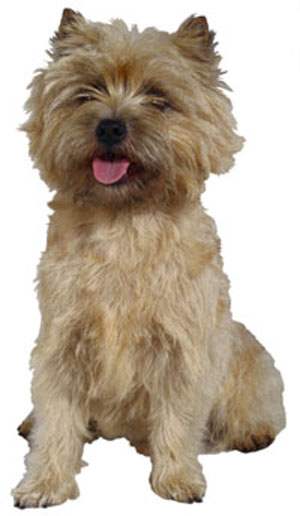
The Cairn Terrier shares a history with Skye Terriers, West Highland White Terriers, and Scottish Terriers. Evidence of these rough-coated terriers has been recorded in Scotland for centuries. Originally, these terriers were used to eradicate vermin and hunt foxes and badgers. The Hebrides archipelago north of Scotland was well-known for the rich cultural history of its islands. Many ancient and not-so-ancient cultures used rock piles to mark graves, conduct religious rituals, create boundaries, and mark locations of special meaning; these rocky structures were called cairns. The little dogs in these areas soon learned that the cairns were a favorite hiding spot of foxes, small animals, and other pests. Thus, the little dogs spent much of their time hunting the local cairns. Because these terriers originated from the Isle of Skye in the Hebrides, they were originally lumped with all of the other Skye Terrier types, including the West Highland and Scottish Terriers. For a time, they were referred to as “Short-Haired Skye Terriers.” However, this distinction did not bode well with the Skye Terrier breeders, and since the second decade of the twentieth century, the three breeds have remained divided into the three modern dogs we see today. The Cairn Terrier experienced a steady growth in popularity after becoming his own breed. Much of the Cairn Terrier’s popularity can be attributed to the breed’s success in cinema. In the film adaption of The Wizard of Oz, the role of Toto was played by a Cairn Terrier named Terry. Over the course of her film career, Terry performed alongside a number of A-list actors and starred in a total of sixteen films.
View Full Breed Standard
 Quick Facts

Group
Terrier Breeds

Life Expectancy
12 - 15 years

Coat Type
Wire coat

Origin
SCOTLAND/GREAT BRITAIN

Weight
14-17 lbs 13-16 lbs

Height
10-12 in 9-11 in
 Breed Ratings
How They Compare
Breed Ratings
How They Compare

Find Cairn Terrier Puppies
Search our CKC registered breeders to find your new best friend!
 Breed History
Tails of Time
Breed History
Tails of Time
The Cairn Terrier shares a history with Skye Terriers, West Highland White Terriers, and Scottish Terriers. Evidence of these rough-coated terriers has been recorded in Scotland for centuries. Originally, these terriers were used to eradicate vermin and hunt foxes and badgers.
The Hebrides archipelago north of Scotland was well-known for the rich cultural history of its islands. Many ancient and not-so-ancient cultures used rock piles to mark graves, conduct religious rituals, create boundaries, and mark locations of special meaning; these rocky structures were called cairns. The little dogs in these areas soon learned that the cairns were a favorite hiding spot of foxes, small animals, and other pests. Thus, the little dogs spent much of their time hunting the local cairns.
Because these terriers originated from the Isle of Skye in the Hebrides, they were originally lumped with all of the other Skye Terrier types, including the West Highland and Scottish Terriers. For a time, they were referred to as “Short-Haired Skye Terriers.” However, this distinction did not bode well with the Skye Terrier breeders, and since the second decade of the twentieth century, the three breeds have remained divided into the three modern dogs we see today.
The Cairn Terrier experienced a steady growth in popularity after becoming his own breed. Much of the Cairn Terrier’s popularity can be attributed to the breed’s success in cinema. In the film adaption of The Wizard of Oz, the role of Toto was played by a Cairn Terrier named Terry. Over the course of her film career, Terry performed alongside a number of A-list actors and starred in a total of sixteen films.
 Breed Standard
Official CKC Standards
Breed Standard
Official CKC Standards
Cairn Terrier
Breed Group 6: Terrier Breeds
Proportions:
Somewhat rectangular in body proportion, the ideal body length (measured from the point of the forechest to the point of the rump) is approximately 15% greater than the body height (measured from the ground to withers) or approximately 1/3 greater than the height at the withers. The Cairn is neither a leggy and square breed nor a low-slung breed. Instead, he appears capable, athletic, and without extremes. The body is well-put-together, with sturdy substance and medium bone. Males should appear masculine, being more substantial in size and mass, while females should appear more feminine and slightly less substantial. Neither should lack overall type. The weight of males or females is always in proportion to height.
Head
- General Appearance: Mesaticephalic skull-type, moderate in size, wedge-shaped beneath the furnishings, and in proportion to the rest of the body. The head is characteristically well-furnished, with somewhat softer hair than what is found on the body. The topskull is broad in proportion to the length of the head, being as wide (from one side to the other, measured in front of the ears) as it is long (from occiput to stop). The topskull may be just slightly (almost imperceptibly) arched from the front or in profile. A median furrow may be evident at the stop. The head is clean-cut, without excess skin or wrinkles.
- Expression: Plucky, confident, lively, watchful, busy, keen, and perhaps with a hint of mischievousness.
- Stop: The stop is moderate to definite.
-
Skull:
The ideal muzzle-to-skull ratio is 4:5, with the topskull being just longer than the muzzle.
The ideal muzzle-to-skull axis is parallel.
- Muzzle: Slightly shorter than the topskull, full, deep, and broad. Upper and lower jaws have good bone substance, appearing strong and well-developed but never snipey or weak.
- Lips or Flews: The lips are clean and fit tightly over the teeth and jaws. They should never appear thick or pendulous.
- Nose: The nose is well-pigmented and black. The nostrils are well-opened.
- Cheeks: The cheeks are well-developed, with some padding to denote powerful jaw strength. The cheeks should not appear chiseled or coarse.
- Dentition and Bite: Forty-two strong, clean, and white teeth. The bite may be level, scissor, or reverse-scissor. Contact must be made between the top and bottom incisors. Missing or broken teeth due to routine work are not to be penalized.
- Eyes: Moderate size, set somewhat wide apart, and may be open-almond or oval. They are dark brown in color. The eye rims are well-fitted and well-pigmented. The eyes are never bulging. There should be sufficient bone in the surrounding orbital sockets to protect the eyes.
- Ears: Small in size, V-shaped, firmly erect, and set high on the skull, yet well apart at the outer edge of the skull. The ears are never long, with only the top 1/3 protruding through the coat. They should never appear overly large, narrow, or broken. Ears should be trimmed free of excess hair that obscures their small size.
Body and Tail
- General Description: Compact, solid, well-muscled, and good substance. The body is never racy or refined. The width at the forequarters is approximately equal to the width at the hindquarters. The build allows for strength, agility, endurance, and stamina.
- Neck: Moderate length allows for proud head carriage and is strongly muscled, with a slight arch. The neck tapers smoothly from the deeper and broader body toward the head. The neck is clean-cut, without excess skin, throatiness, or dewlap.
- Chest: Deep and broad but never wider than deep. The brisket extends to the point of the elbows.
- Topline: Level from slightly prominent withers to croup. The back is somewhat long, broad, strongly muscled, straight, and supple. The loin is rather short, taut, flat, and level. The topline is never swayed or roached.
- Croup: Flat and level with the back.
- Underline: A slight tuck-up may be present, or the underline may run parallel to the topline. The underline is taut and firm, without any indication of sagging or excess weight.
- Ribs: Long, well-sprung, well-laid-back, oval-shaped, never barrel-chested or slab-sided.
- Tail: Set neither high nor low on the croup, thick at the base and tapering toward the tip. The tail is carried gaily (between the 12 and 2 o’clock position preferred) when the dog is alert or in motion but may be carried downward in a neutral position when the dog is in repose. The tail may be left natural (preferred) or docked to a medium length. Natural tails are long, with the tip of the last vertebrae extending to the hock joints when held down. The tail may be straight or gently curved. Docked tails are cut to a medium length, with the tip being level with the head when held up.
Forequarters and Hindquarters
- Forequarters: The forequarters are always balanced with the hindquarters and well-angulated with well-laid-back shoulder blades. Shoulder blades are approximately equal in length to the upper arm and forearm.
- Elbows: The elbows are close to the body. The point of the elbows is approximately half the dog’s height at the withers.
-
Forelegs:
Frontal View: Straight, of good muscle and bone, and parallel to one another.
Side View: The forelimbs appear straight with strong pasterns.
- Pasterns: Never weak or broken.
-
Hindquarters:
The upper and lower thighs are equal in length, strong, sturdy, of good bone, and well-muscled.
Rear View: When viewed from the rear, the rear pasterns are parallel to one another.
Side View: Good angulation will allow the rear toes to align with the point of the rump or within one to two paw-lengths behind the point of the rump, with the rear pasterns remaining perpendicular to the ground and parallel to one another. - Stifle Joint: Well-angulated with a good bend to well-let-down rear pasterns.
- Stifle Joint: The angulation of the hindquarters is always in balance with the angulation of the forequarters.
- Feet: Oval to round and compact, with well-arched toes and tough pads. Forefeet may be oriented outward just slightly and may be slightly larger than the hind feet.
Coat
- Skin: Well-fitted, yet supple. The skin should never obstruct the outline of the dog.
- Coat Type: Harsh, weather-resistant outer coat with short, close, soft, abundant undercoat, slight wave permissible. The tail is well-furred but not bushy or plumed. Cairns require minimal grooming, including tidying of the head and ears and regular stripping. Otherwise, altering the coat with scissors or clippers is to be penalized in the show ring.
-
Coat Color or Pattern:
CKC recognizes two color varieties of the Cairn Terrier breed: the standard and the nonstandard.
Standard Coat Color Variety: Solid colors including cream, wheaten, red, grey, grey-black, and brindle, all with or without dark points (mask and mask extension).
Non-Standard Coat Color Variety: Black with or without tan points, any of the standard or non-standard colors with or without white markings (particolored), or solid white.
Movement
The Cairn Terrier’s original purpose required that he be able to locate, track, hunt, dig, and dispatch a variety of different animals all throughout the day. This requires energetic, balanced, powerful, and agile movement. All of the characteristics of a healthy structure are evident. When moving away, the forelegs and rear pasterns should remain parallel to one another. When viewing movement from the front, the forelegs should remain parallel, with elbows and paws moving neither in nor out. From the rear, the back pads should be visible when the rear legs are extended. As speed increases, the forelimbs and hindlimbs will converge to the center line of gravity. From the side, the topline should remain firm and level. Good reach of movement in the front allows the forepaw to extend out in line with the nose. When extended, the width between the forefeet should be approximately equal to the width between the hindfeet when extended, indicating balance, good reach, and good drive. Dogs that exhibit any sign of breathing or locomotive difficulty shall be disqualified from the show ring.
Temperament
The Cairn Terrier is known for their Terrier tenacity and love of people. They are busy, lively, and hardy dogs. When necessary, he exhibits courage and game. Also, they can be quite devoted and tender with their people. As with most terriers, special care should be taken to ensure that they are introduced and socialized to other dogs and household pets. Many Cairns do not do well with smaller animals (such as rodents) since they may trigger the dog’s prey drive. The Cairn is an intelligent breed that takes on learning many tasks and disciplines with enthusiasm. Overall, they are assertive yet friendly. Any unprovoked aggressive or fearful behavior toward people is incorrect for this breed.
Faults
All dogs should be in proper healthy condition, free from disease or defect. Any departure from this description is considered a fault. Unless altered, all male dogs should have two fully descended testicles.

Take our Dog Breed Match Quiz!
What is the best dog breed for you? Take our quiz!