
meet the... Shih Tzu
The exact origin of the Shih Tzu breed is unknown, but a dog with similar characteristics appeared in Oriental paintings dating back to 600 CE. The Shih Tzu’s ancestors are traced back to the temples of Tibet, where the Tibetan Lion Dogs were highly regarded as sacred animals. Only the most distinguished citizens were allowed to own them, and any person who harmed or stole a Shih Tzu could be put to death. The Shih Tzu breed was eventually brought to China, the country credited with the breed’s development, during the seventeenth century CE. During the Manchu Dynasty, Chinese emperors were given Shih Tzus as a token of kindness and good fortune. It became customary for all distinguished Chinese visitors to be presented with a pair. Although the Shih Tzu faced extinction during the Chinese Revolution, one ruler, Empress Dowager Cixi, had been an avid breeder of the Shih Tzu. It is thought that some of her eunuchs sold some of the palace’s dogs to wealthy countrymen and foreign dignitaries. Although the death of the empress in 1908 ended an era for the Shih Tzu in China, its popularity continued to grow in the Scandinavian countries, Holland, England, and the United States after its introduction in the 1930s.
View Full Breed Standard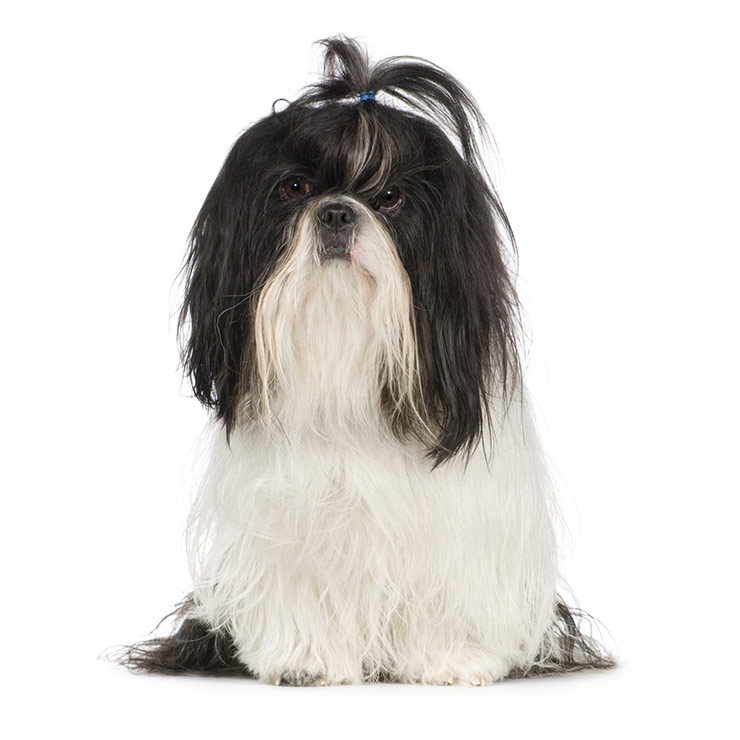
The exact origin of the Shih Tzu breed is unknown, but a dog with similar characteristics appeared in Oriental paintings dating back to 600 CE. The Shih Tzu’s ancestors are traced back to the temples of Tibet, where the Tibetan Lion Dogs were highly regarded as sacred animals. Only the most distinguished citizens were allowed to own them, and any person who harmed or stole a Shih Tzu could be put to death. The Shih Tzu breed was eventually brought to China, the country credited with the breed’s development, during the seventeenth century CE. During the Manchu Dynasty, Chinese emperors were given Shih Tzus as a token of kindness and good fortune. It became customary for all distinguished Chinese visitors to be presented with a pair. Although the Shih Tzu faced extinction during the Chinese Revolution, one ruler, Empress Dowager Cixi, had been an avid breeder of the Shih Tzu. It is thought that some of her eunuchs sold some of the palace’s dogs to wealthy countrymen and foreign dignitaries. Although the death of the empress in 1908 ended an era for the Shih Tzu in China, its popularity continued to grow in the Scandinavian countries, Holland, England, and the United States after its introduction in the 1930s.
View Full Breed Standard
 Quick Facts

Group
Companion and Toy Breeds

Life Expectancy
11 - 15 years

Coat Type
Long coat

Origin
TIBET/CHINA

Weight
9-18 lbs 9-18 lbs

Height
8-11 in 8-11 in
 Breed Infographic Video
All You Need to Know
Breed Infographic Video
All You Need to Know
 Breed Ratings
How They Compare
Breed Ratings
How They Compare

 Breed History
Tails of Time
Breed History
Tails of Time
The exact origin of the Shih Tzu breed is unknown, but a dog with similar characteristics appeared in Oriental paintings dating back to 600 CE. The Shih Tzu’s ancestors are traced back to the temples of Tibet, where the Tibetan Lion Dogs were highly regarded as sacred animals. Only the most distinguished citizens were allowed to own them, and any person who harmed or stole a Shih Tzu could be put to death.
The Shih Tzu breed was eventually brought to China, the country credited with the breed’s development, during the seventeenth century CE. During the Manchu Dynasty, Chinese emperors were given Shih Tzus as a token of kindness and good fortune. It became customary for all distinguished Chinese visitors to be presented with a pair.
Although the Shih Tzu faced extinction during the Chinese Revolution, one ruler, Empress Dowager Cixi, had been an avid breeder of the Shih Tzu. It is thought that some of her eunuchs sold some of the palace’s dogs to wealthy countrymen and foreign dignitaries. Although the death of the empress in 1908 ended an era for the Shih Tzu in China, its popularity continued to grow in the Scandinavian countries, Holland, England, and the United States after its introduction in the 1930s.
 Breed Standard
Official CKC Standards
Breed Standard
Official CKC Standards
Shih Tzu
Breed Group 12: Companion and Toy Breeds
Breed Name Aliases
Chinese Lion Dog, Chrysanthemum Dog
Proportions:
Rectangular in proportion, with the length of the body, measured from the point of the forechest to the point of the rump, being just slightly greater than the height at the withers. The ideal body height-to-length ratio is approximately 8:5. The body is well-put-together, with sturdy substance and medium bone. Males should appear masculine, being more substantial in size and mass, while females should appear more feminine and slightly less substantial. Neither should lack overall type. The Shih Tzu should appear neither excessively upright nor extremely short. The weight of a male or female is always in proportion to height.
Head
- General Appearance: Somewhat brachycephalic skull-type, rounded, and in proportion to the rest of the body. It is never narrow or elongated. However, the nose and muzzle should protrude enough to prevent a flat appearing profile. The topskull is well-rounded, or domed and broad, with a sufficient skull between the eyes. It should appear, or feel, arched in all directions. It should never appear or feel flat. The head is clean-cut without excess skin or wrinkles.
- Expression: Bright-eyed, charming, and friendly.
- Stop: The stop is definite, preferably forming a 90-degree angle between the topskull and muzzle.
-
Skull:
The ideal muzzle-to-skull ratio is 7:1, with the topskull being just longer than the muzzle.
The ideal muzzle-to-skull axis is convergent. - Muzzle: The muzzle is short, square (being wide from top to bottom, as well as side to side), and without a wrinkle. The ideal muzzle length is one inch but may vary slightly in proportion to the overall size of the dog. The plane of the muzzle is level or may turn up slightly. When viewed from the side, the end of the muzzle should be flat. When viewed from the front, the nose should align with or drop just below the bottom eye rim. The jaws are broad and wide.
- Lips or Flews: The lips are broad, fit tightly, and cover all teeth. They are never pendulous or loose. The lower jaw and teeth neither protrude from the lips nor recede. The lips are well-pigmented.
- Nose: The nose is well-pigmented and black or self-colored according to the coat. The nostrils are well opened.
- Cheeks: There is sufficient fill in the cheeks to prevent a chiseled appearance while keeping with the compact appearance of the dog. The cheeks should not appear chiseled or coarse.
- Dentition and Bite: Forty-two strong, clean, and white teeth. The bite may be level, scissor, reverse-scissor, or a tight undershot bite. Contact should be made between the top and bottom incisors. Excessive undershot bites, which include loss of contact of incisors or those that result from extreme muzzle layback and long lower jaw, are not correct. Also, bites resulting in the lower jaw protruding beyond the lips are incorrect, as teeth and tongue should always be concealed when the mouth is closed.
- Eyes: Moderately large in size, open oval to somewhat round in shape, and preferably dark in color. The eye rims are well-fitted and well-pigmented. The eyes are never bulging, prominent, or bugged. They do not feature exposed whites or pink membranes. There should be sufficient bone in the surrounding orbital sockets to protect the eyes.
- Ears: The ears are medium to moderately large in size, set slightly below the plane of the skull, and may be drop to slightly pendulous in shape. They hang close to the head and are triangular.
Body and Tail
- General Description: Well-balanced, compact, solid, and short-coupled. The body is never racy, nor is it refined. The width at the forequarters is approximately equal to the width at the hindquarters.
- Neck: The neck is sufficient in length to permit a natural proud head carriage and is strongly muscled with a slight arch. The neck tapers smoothly from the deeper and broader body toward the head. The neck is clean-cut, without excess skin, throatiness, or dewlap.
- Chest: Deep and broad, but never wider than deep. The brisket extends to the point of the elbows.
- Topline: Level from withers to croup. The back is broad, strongly muscled, and straight, yet supple. The loin is taut, flat, and level. The back is never swayed or roached.
- Croup: Flat and level with the back.
- Underline: A slight tuck-up is present. The underline is taut and firm, without any indication of sagging or excess weight.
- Ribs: Long, well-sprung, well-laid-back, oval-shaped, never barrel-chested or slab-sided.
- Tail: Set high on the croup, thick at the base and tapering toward the tip. It is carried in a gentle curve well over the back, never carried flagged, flat on the back, or tucked. The height of the tail, when carried properly, should be in line with the height of the head. The tail is of a medium length, with the tip of the last vertebrae extending to the hock joints when held down.
Forequarters and Hindquarters
- Forequarters: The forequarters are always in balance with the hindquarters and well-angulated with well-laid-back shoulder blades. Shoulder blades are approximately equal in length to the upper arm and forearm.
- Elbows: The elbows are close to the body. The distance from the withers to the brisket may be equal to or just greater than the distance from the elbows to the ground.
-
Forelegs:
Frontal View: Straight, of good muscle, of moderate bone, and parallel to one another.
Side View: The forelimbs appear straight with strong pasterns. - Pasterns: Never weak or broken.
-
Hindquarters:
The upper and lower thighs are equal in length, strong, sturdy, of moderate bone, and well-muscled.
Rear View: When viewed from the rear, the rear pasterns are parallel to one another.
Side View: Good angulation will allow the rear toes to align with the point of the rump or within one to two paw-lengths behind the point of the rump, with the rear pasterns remaining perpendicular to the ground and parallel to one another. - Stifle Joint: Well-angulated with a good bend to well-let-down rear pasterns.
- Stifle Joint: Angulation of hindquarters is always in balance with angulation of forequarters.
- Feet: Oval to round and compact, with well-arched toes and tough pads.
Coat
- Skin: Well-fitted, yet supple. The skin should never obstruct the outline of the dog.
- Coat Type: The coat is long and consists of a dense, long outer coat and a moderate undercoat. It is never woolly, curly, or rough. A slight wave is permissible. Hair on the head may be trimmed or pulled back. The coat should never restrict or impede a dog's movement. The ears and tail are abundantly feathered with long hair.
- Coat Color or Pattern: All coat colors and patterns are equally permissible.
Movement
The Shih Tzu possesses a smooth, flowing gait with graceful movements. The characteristics of a healthy structure are evident. When moving away, the forelegs and rear pasterns should remain parallel to one another. When viewing movement from the front, the forelegs should remain parallel, with elbows and paws moving neither in nor out. From the rear, the back pads should be visible when the rear legs are extended. As speed increases, the forelimbs and hindlimbs will converge to the centerline of gravity. From the side, the topline should remain firm and level. Good reach of movement in the front allows the forepaw to extend out in line with the nose. The width between the forefeet, when extended, should be approximately equal to the width between the hindfeet when extended, indicating balance, good reach, and good drive. Dogs that exhibit any sign of breathing or locomotive difficulty shall be disqualified from the show ring.
Temperament
A true companion breed from its beginning, the Shih Tzu should exhibit a perpetually friendly, happy, and affectionate nature. Any unprovoked aggressive or fearful behavior toward people is incorrect for this breed.
Faults
All dogs should be in proper healthy condition, free from disease or defect. Any departure from this description is considered a fault. Unless altered, all male dogs should have two fully descended testicles.

Take our Dog Breed Match Quiz!
What is the best dog breed for you? Take our quiz!