
meet the... Bichon Frise
The Bichon Frise is an ancient breed of the “bichon” family, with bichon being the Middle French word meaning “small long-haired lapdog.” The exact origin of this merry breed remains a mystery. However, it is believed to have originated in the central Mediterranean, Sicily, Egypt, and various parts of Europe. Like the Bichon Bolognese, Maltese, and Havanese, the origins of the Bichon Frise—also known as the Bichon Tenerife—are shrouded in mystery. This is due largely to the fact that the Bichon types were similar not only in appearance and size but also in origin, making it difficult to determine the exact route of each breed’s exact history. The Tenerife hails from the Canary Islands, located off of the coast of Spain. This was a popular port of call with sailors and traders who found these cheery little dogs to be suitable companions for lengthy stints at sea. The Tenerife dogs were true seaman’s dogs, keeping lonely sailors company with their endearing nature and entertaining them with their antics. The sailors and traders brought these little dogs with them throughout all of their ports of call, eventually making their way to France. There, the Tenerife became an instant hit with French Royalty, where they became an extension of the French Monarchy’s façade. The dogs were crossed with local poodles and barbets, giving them a luxurious curly coat that could be styled in various ways. These lavish little lap dogs charmed numerous French aristocrats for centuries, including King Henry III. It was said that he carried his Bichons around with him in a basket wherever he went. There, the Bichons, now referred to as Bichon à poil frisé (meaning “Bichon with the curly hair”), enjoyed a life in the lap of royalty. Unfortunately, the fate of the favored pup would soon take a different turn. Between 1789 and 1799, during the French Revolution, the breed lost its luxurious position and was quite literally tossed out onto the streets. Like all good dogs, the Bichon could not be kept down. Soon the Bichon Frise’s charming demeanor attracted the attention of commoners, peasants, street vendors, and circus performers. Realizing their charm and intelligence, the Bichon became a staple in street performances and the big ring, traveling the world and spreading the breed’s popularity. Despite its threatened existence during both World Wars, the Bichon became one of the most popular companion dogs in the United States during the 1980s, when he was dubbed the “yuppie puppy” and once again enjoyed a life in the lap of luxury. Today, the Bichon is a popular dog breed enjoyed by people of all different socioeconomic backgrounds. They are still renowned for their beauty, charm, and loving demeanor.
View Full Breed Standard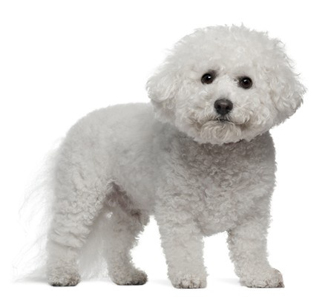
The Bichon Frise is an ancient breed of the “bichon” family, with bichon being the Middle French word meaning “small long-haired lapdog.” The exact origin of this merry breed remains a mystery. However, it is believed to have originated in the central Mediterranean, Sicily, Egypt, and various parts of Europe. Like the Bichon Bolognese, Maltese, and Havanese, the origins of the Bichon Frise—also known as the Bichon Tenerife—are shrouded in mystery. This is due largely to the fact that the Bichon types were similar not only in appearance and size but also in origin, making it difficult to determine the exact route of each breed’s exact history. The Tenerife hails from the Canary Islands, located off of the coast of Spain. This was a popular port of call with sailors and traders who found these cheery little dogs to be suitable companions for lengthy stints at sea. The Tenerife dogs were true seaman’s dogs, keeping lonely sailors company with their endearing nature and entertaining them with their antics. The sailors and traders brought these little dogs with them throughout all of their ports of call, eventually making their way to France. There, the Tenerife became an instant hit with French Royalty, where they became an extension of the French Monarchy’s façade. The dogs were crossed with local poodles and barbets, giving them a luxurious curly coat that could be styled in various ways. These lavish little lap dogs charmed numerous French aristocrats for centuries, including King Henry III. It was said that he carried his Bichons around with him in a basket wherever he went. There, the Bichons, now referred to as Bichon à poil frisé (meaning “Bichon with the curly hair”), enjoyed a life in the lap of royalty. Unfortunately, the fate of the favored pup would soon take a different turn. Between 1789 and 1799, during the French Revolution, the breed lost its luxurious position and was quite literally tossed out onto the streets. Like all good dogs, the Bichon could not be kept down. Soon the Bichon Frise’s charming demeanor attracted the attention of commoners, peasants, street vendors, and circus performers. Realizing their charm and intelligence, the Bichon became a staple in street performances and the big ring, traveling the world and spreading the breed’s popularity. Despite its threatened existence during both World Wars, the Bichon became one of the most popular companion dogs in the United States during the 1980s, when he was dubbed the “yuppie puppy” and once again enjoyed a life in the lap of luxury. Today, the Bichon is a popular dog breed enjoyed by people of all different socioeconomic backgrounds. They are still renowned for their beauty, charm, and loving demeanor.
View Full Breed Standard
 Quick Facts

Group
Companion and Toy Breeds

Life Expectancy
14 - 15 years

Coat Type
Curly coat

Origin
FRANCE

Weight
7-12 lbs 7-12 lbs

Height
9-12 in 9-12 in
 Breed Infographic Video
All You Need to Know
Breed Infographic Video
All You Need to Know
 Breed Ratings
How They Compare
Breed Ratings
How They Compare

Find Bichon Frise Puppies
Search our CKC registered breeders to find your new best friend!
 Breed History
Tails of Time
Breed History
Tails of Time
The Bichon Frise is an ancient breed of the “bichon” family, with bichon being the Middle French word meaning “small long-haired lapdog.” The exact origin of this merry breed remains a mystery. However, it is believed to have originated in the central Mediterranean, Sicily, Egypt, and various parts of Europe. Like the Bichon Bolognese, Maltese, and Havanese, the origins of the Bichon Frise—also known as the Bichon Tenerife—are shrouded in mystery. This is due largely to the fact that the Bichon types were similar not only in appearance and size but also in origin, making it difficult to determine the exact route of each breed’s exact history.
The Tenerife hails from the Canary Islands, located off of the coast of Spain. This was a popular port of call with sailors and traders who found these cheery little dogs to be suitable companions for lengthy stints at sea. The Tenerife dogs were true seaman’s dogs, keeping lonely sailors company with their endearing nature and entertaining them with their antics. The sailors and traders brought these little dogs with them throughout all of their ports of call, eventually making their way to France. There, the Tenerife became an instant hit with French Royalty, where they became an extension of the French Monarchy’s façade. The dogs were crossed with local poodles and barbets, giving them a luxurious curly coat that could be styled in various ways. These lavish little lap dogs charmed numerous French aristocrats for centuries, including King Henry III. It was said that he carried his Bichons around with him in a basket wherever he went. There, the Bichons, now referred to as Bichon à poil frisé (meaning “Bichon with the curly hair”), enjoyed a life in the lap of royalty. Unfortunately, the fate of the favored pup would soon take a different turn. Between 1789 and 1799, during the French Revolution, the breed lost its luxurious position and was quite literally tossed out onto the streets.
Like all good dogs, the Bichon could not be kept down. Soon the Bichon Frise’s charming demeanor attracted the attention of commoners, peasants, street vendors, and circus performers. Realizing their charm and intelligence, the Bichon became a staple in street performances and the big ring, traveling the world and spreading the breed’s popularity.
Despite its threatened existence during both World Wars, the Bichon became one of the most popular companion dogs in the United States during the 1980s, when he was dubbed the “yuppie puppy” and once again enjoyed a life in the lap of luxury. Today, the Bichon is a popular dog breed enjoyed by people of all different socioeconomic backgrounds. They are still renowned for their beauty, charm, and loving demeanor.
 Breed Standard
Official CKC Standards
Breed Standard
Official CKC Standards
Bichon Frise
Breed Group 12: Companion and Toy Breeds
Breed Name Aliases
Bichon a Poil Frise, Bichon Tenerife, Bichon, Tenerife
Proportions:
The Bichon Frise is an off-square to just slightly rectangular breed. The length from the withers to the tail set is equal to the distance from the withers to the ground. The length of the body (from the point of the forechest to the point of the rump) exceeds the height at the withers by 11-25%. The body should never appear overly rectangular or low to the ground. The substance is sturdy and medium-boned. The weight of males or females is always in proportion to height.
Head
- General Appearance: Mesaticephalic skull-type, moderate in size and in proportion to the rest of the body. The skull may be flat to the touch to slightly rounded, with the coat giving it a more exaggerated rounded appearance. The head is clean-cut without excess skin or wrinkles.
- Expression: The expression is gentle, soft, alert, and inquisitive.
- Stop: The stop may be slightly accentuated to somewhat marked.
-
Skull:
The ideal muzzle-to-skull ratio is 3:5, with the topskull being just longer than the muzzle.
The ideal muzzle-to-skull axis is convergent.
- Muzzle: Shorter than the topskull. The muzzle is full, deep, and broad. The bridge of the muzzle is level and straight from the stop to the tip of the nose. Upper and lower jaws have good bone substance, appearing strong and well-developed, never appearing snipey or weak.
- Lips or Flews: The lips are clean and fit tightly over the teeth and jaws. The lips should not appear pendulous or droopy.
- Nose: The nose is well-pigmented, black, or self-colored, according to the coat. The nostrils are well-opened.
- Cheeks: Cheeks may be flat or slightly padded. The cheeks should not appear chiseled or coarse.
- Dentition and Bite: Forty-two strong, clean, and white teeth. The bite may be level, scissor, or reverse-scissor. Contact must be made between the top and bottom incisors. Missing or broken teeth due to routine work are not to be penalized.
- Eyes: Moderate in size, round in shape, and dark brown in color. The eye rims are well-fitted, well-pigmented, and black, further emphasizing the expression. The whites of the eyes should not be visible. The eyes are never bulging. There should be sufficient bone in the surrounding orbital sockets to protect the eyes.
- Ears: Medium in size, set high on the skull, and drop, set just higher than eye level and forward. When alerted, the ears should fall forward and frame the face. The leathers should hang close to the head. When extended, the tips should reach the midway point of the muzzle. The ears are never long, overly large, or broken.
Body and Tail
- General Description: Compact, solid, and good substance. The body is never racy or refined. The width at the forequarters is approximately equal to the width at the hindquarters.
- Neck: Moderate length allows for proud head carriage and does not appear short with the thick coat. Approximately 1/3 the distance of the total body length. It is strongly muscled, with a slight arch. The neck tapers smoothly from the deeper and broader body toward the head. The neck is clean-cut, without excess skin, throatiness, or dewlap.
- Chest: Deep and broad but never wider than deep. The brisket extends to the point of the elbows.
- Topline: Level from withers to croup. The back is broad, strongly muscled, and straight, yet supple. The loin is taut, flat, and level. The topline is never swayed or roached.
- Croup: Gently sloped.
- Underline: A slight tuck-up is present. The underline runs parallel to the topline. The underline is taut and firm, without any indication of sagging or excess weight.
- Ribs: Long, well-sprung, well-laid-back, oval-shaped, never barrel-chested or slab-sided.
- Tail: Set high on the croup and level with the topline, or may fall just below the horizontal. Thick at the base and tapering toward the tip. Carried in accordance with the dog’s mood and energy level, usually curved up over the back but never tucked. The tail is of a medium length, with the tip of the last vertebrae extending to the hock joints when held down. It should reach the halfway point to the withers when extended forward over the back.
Forequarters and Hindquarters
- Forequarters: The forequarters are always balanced with the hindquarters and well-angulated with well-laid-back shoulder blades. Shoulder blades are approximately equal in length to the upper arm and forearm.
- Elbows: The elbows are close to the body. The point of the elbows is approximately half the dog’s height at the withers.
-
Forelegs:
Frontal View: Straight, of good muscle and bone, and parallel to one another.
Side View: The forelimbs appear straight with strong pasterns.
- Pasterns: Never weak or broken.
-
Hindquarters:
The upper and lower thighs are equal in length, strong, sturdy, of good bone, and well-muscled.
Rear View: When viewed from the rear, the rear pasterns are parallel to one another.
Side View: Good angulation will allow the rear toes to align with the point of the rump or within one paw-length behind the point of the rump, with the rear pasterns remaining perpendicular to the ground and parallel to one another. - Stifle Joint: Well-angulated with a good bend to well-let-down rear pasterns.
- Stifle Joint: The angulation of the hindquarters is always in balance with the angulation of the forequarters.
- Feet: Oval to round, compact, with well-arched toes and tough pads.
Coat
- Skin: Well-fitted, yet supple. The skin should never obstruct the outline of the dog.
- Coat Type: Soft, fine, silky, dense, coarse, tight, cork-screw curls outer coat. When touched, the coat will spring back into place. When blown dry, the coat is reminiscent of a cotton ball. The undercoat is soft and dense. The ears are well-feathered, and the tail is well-plumed. Never flat, wavy, rough, corded, or without an undercoat. Two to four inches in length.
- Coat Color or Pattern: The coat should be white. However, light tan, biscuit, cream, or apricot shadings on the ears or body are permissible.
Movement
The Bichon’s movement is free, energetic, and effortless. The characteristics of a healthy structure are evident. When moving away, the forelegs and rear pasterns should remain parallel to one another. When viewing movement from the front, the forelegs should remain parallel, with elbows and paws moving neither moving in nor out. From the rear, the back pads should be visible when the rear legs are extended. As speed increases, the forelimbs and hindlimbs will converge to the center line of gravity. From the side, the topline should remain firm and level. Good reach of movement in the front allows the forepaw to extend out in line with the nose. When extended, the width between the forefeet should be approximately equal to the width between the hindfeet when extended, indicating balance, good reach, and good drive. Dogs that exhibit any sign of breathing or locomotive difficulty shall be disqualified from the show ring.
Temperament
The Bichon Frise breed is well-known for their gentle, merry, and affable temperament. Their intelligence and eagerness to be with their family make them wonderful companions. They are known to be good-natured, sensitive, and playful. Any unprovoked aggressive or fearful behavior toward people is incorrect for this breed.
Faults
All dogs should be in proper healthy condition, free from disease or defect. Any departure from this description is considered a fault. Unless altered, all male dogs should have two fully descended testicles.

Take our Dog Breed Match Quiz!
What is the best dog breed for you? Take our quiz!