
Home Fitness Training for Dogs: Mobility Exercises
There is no stopping time, a fact that many dog owners truly dread, but there are things we can do to help our dogs prevent the onset of painful injuries. Integrating simple exercises that build strength and form can improve joint health, reduce the impact of aging, and enhance our home training.
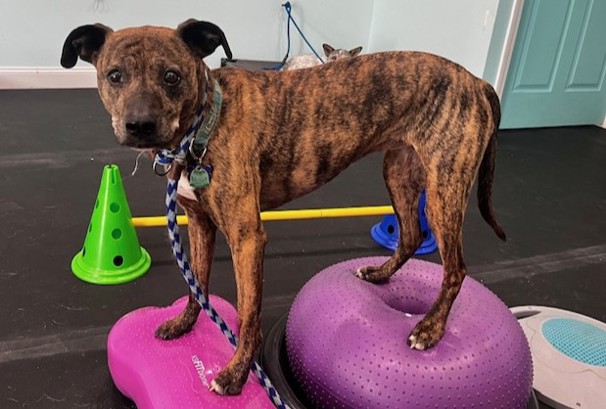
Image provided by Ejay Eisen (Founder, Director of Ruff Translating)
There is no stopping time, a fact that many dog owners truly dread, but there are things we can do to help our dogs prevent the onset of painful injuries. Integrating simple exercises that build strength and form can improve joint health, reduce the impact of aging, and enhance our home training.
Your Dog’s Mobility
We all dread the moment when our dog develops a limp. It is so concerning to see your companion hurting, but it can also be difficult to identify the source and treat it. Sometimes an injury can be alleviated with rest, though keeping an active dog quiet is oftentimes its own challenge!
If there is an issue that requires orthopedic treatment, that can be even more invasive. Our dogs can suffer breaks, sprains, and, as they age, develop conditions like hip and elbow dysplasia, as well as arthritis.
One very expensive and common veterinary cost dog owners can encounter is a cranial cruciate ligament tear, which is the semi-equivalent of a human athlete needing a new ACL.
What these injuries and conditions have in common is that they limit a dog’s mobility, sometimes for long durations, and have the potential to impact quality of life. This is where curated exercise plays its part in long-term canine health.
The Importance of Meaningful Exercise
The common perception is that a dog has to be running at top speed and panting for something to count as “exercise,” and while cardiovascular activity is certainly important, dogs can benefit from strength and balance-building exercises.
Many times, an injury can be caused by a dog making a misstep or having less body awareness than they need when moving at high speeds because they just haven’t been conditioned to use their bodies thoughtfully!
When we are playing impactful games with our dogs, like fetch or frisbee, there are even some guidelines now being introduced from veterinary professionals to help make safer choices when exercising our pets.
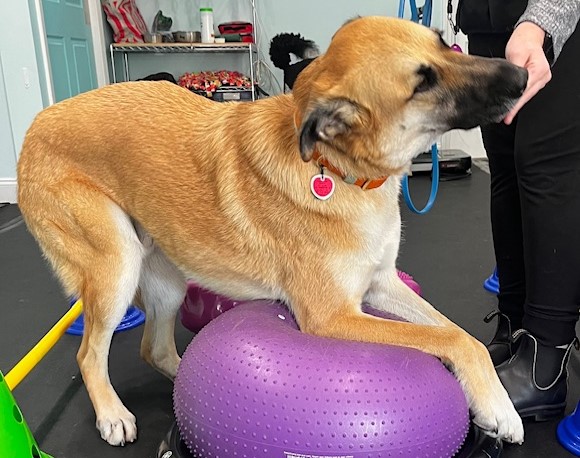 Image provided by Ejay Eisen (Founder, Director of Ruff Translating)
Specialized Exercises for You to Practice with Your Pup
Exercises that build core strength and develop solid muscle groups do not require many elaborate commands, but starting a program may require a dog to be able to follow a lure and know some basic cues, including down, stand, front paws up, sit, and spin/twist.
As a dog learns, we can add in so many more cues; many pets find great enjoyment in their time at the “dog gym” and learn more advanced techniques.
Using equipment that promotes a dog’s balance is often recommended as they move up in their skills, and there are training classes at facilities to teach pet owners how to safely lead their dogs into more challenging exercises.
Try this Starter Exercise!
The simplest of starter exercises include examples such as practicing “push-ups”. A “push up” involves bringing the dog into a “down” with their joints aligned underneath them, and then luring them into a “stand” without shifting their foot position, to activate their shoulders and hips. This action activates muscle groups across the dog's hips and shoulders, but also challenges the stability of elbows and knees when repeated.
Tip: The placement of a dog’s feet, shoulders, hips, and neck is important when learning how to do fitness routines!
Conclusion
The benefit of starting a home fitness program with your dog is a happier, healthier dog, weight management, injury prevention, and a more satisfying training relationship.
We don’t have to train our dogs to run in marathons or pull sleds if that isn’t our passion– but integrating some basic fitness is a wonderful way to be a more present owner and keep the limping days at bay.


 Muhammad Saad

