
Seeing-Eye Guide Dog Anniversary: Celebrating the Many Tasks of a Well-Trained Guide Dog
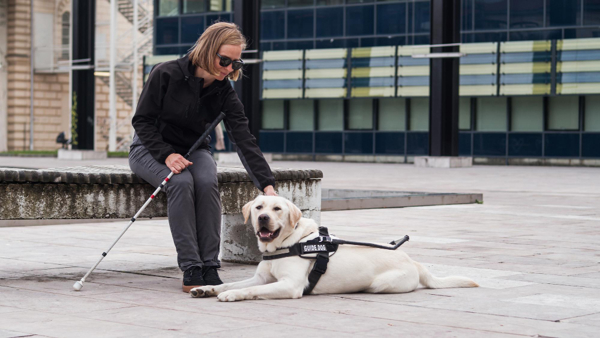
Whether a guide dog is helping someone get to a bus stop, walk around an obstacle, or find an exit, these dogs are always looking out for their person’s safety. Though we may have had these incredible working dogs in the United States for almost one hundred years, we are still learning daily just how much they have to offer!
A Brief History of Guide Dogs
When the public imagines a “service dog”, the first picture that frequently presents is a working guide dog assisting someone who is visually impaired. This is with good reason!
Guide Dogs as we know them today originated in the United States in 1928, with Morris Frank and his guide dog, Buddy, who was trained in Switzerland by Dorothy Eustis. With Morris and Buddy’s success, the development of the first U.S.-based guide dog school, The Seeing Eye, began in Tennessee while continuing to be led by Morris and Dorothy.
This was certainly not the first time that an intrepid individual had trained a good dog to assist them with a disability, with Roman records and many other cultural artifacts depicting dogs with guiding-like characteristics over the length of human history.
So then, what can these amazing dogs do to help with disabilities that impact vision?
The Role of Guide Dogs
There is a misconception that Guide Dogs “steer” their handlers, when in fact the handlers are always the ones fully in control of their assistance animals.
The dog’s role is to warn of obstacles and dangers and perform other tasks related to improving accessibility to the world, not built for those without a full range of sight. For some dogs, that might include picking up a dropped object, for others, that might include pushing the button at a crosswalk for a handler. Some guide dogs are also taught to find seating!
Guide Dogs can be taught routes and typical walks that help them be more familiar with their environments, so that when obstacles occur, they are more prepared to navigate around. Many are taught to recognize specific public transit pickup locations as well.
Exceptional Training Can Be Life Saving
Guide Dogs can also assist by locating exits for handlers, which is not only helpful in larger spaces but also can be imperative in an emergency.
To be effective as Guide Dogs, canine candidates must have an exceptional temperament and be able to handle lots of distractions. Many notable programs choose to invest in researching and breeding for specific traits to accomplish this more consistently.
The results of a well-trained dog are certainly undeniable; notably, two guide dogs assisted their handlers through the 2001 September 11th attacks in NYC. Both Salty and Roselle were steady and true despite the chaos, keeping their handlers safe while guiding them out of the buildings.

More Conditions to Consider: Psychiatric Service Dogs
When we think about a “visual impairment,” most of the time we are talking about vision loss to some degree. Certainly, not all guide dog handlers have lost their complete vision, and the community varies in conditions related to vision loss.
There are more conditions to include and consider in relation to how dogs can assist with what we “see” or “don’t see.” For example, when training psychiatric service dogs for those with hallucinations, dogs have been successfully trained to tell the difference between “is something there or not” and reassure their handler.
This can reduce anxiety and allow that person to access what supports they may need to alleviate those symptoms that are creating visual disturbances. This type of de-escalation can be absolutely imperative for those living with conditions that cause hallucinations.
It’s not quite the same as traditional guide dog work, but it allows the dog to be the handler’s “eyes” when their own are not cooperating with their mind!
Service Dog Training
The process as a whole can be so much more involved than the public may realize. A great deal of work has gone into a great guide dog team, smoothly navigating.
Training for these important tasks generally takes two years of practice for the dogs learning them, and not every dog that begins the process will be successful.
The handler of the guide dog also has to go through specialized training, usually with the organization working with the dog to learn how to work as a team and access the dog’s special skills.
Conclusion
Whether a guide dog is helping someone get to a bus stop, walk around an obstacle, or find an exit, these dogs are always looking out for their person’s safety.
Though we may have had these incredible working dogs in the United States for almost one hundred years, we are still learning daily just how much they have to offer!


 Fay Smith

