
meet the... Wirehaired Pointing Griffon
Created in the 1870s by Edward K. Korthals, the Wirehaired Pointing Griffon was developed by the crossing of old-type griffon dogs, pointers, and spaniels to produce an intelligent, water-loving, close-working pointing griffon. They are often confused with the German Wirehaired Pointer and German Rough-haired Pointer.
View Full Breed Standard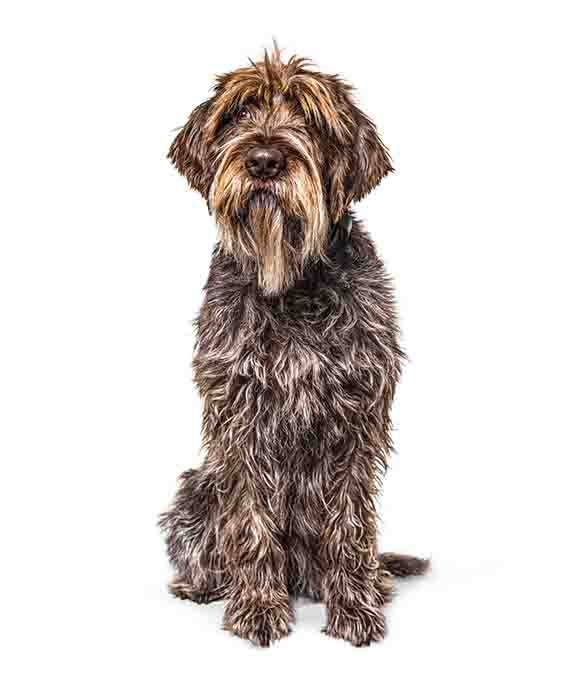
Created in the 1870s by Edward K. Korthals, the Wirehaired Pointing Griffon was developed by the crossing of old-type griffon dogs, pointers, and spaniels to produce an intelligent, water-loving, close-working pointing griffon. They are often confused with the German Wirehaired Pointer and German Rough-haired Pointer.
View Full Breed Standard
 Quick Facts

Group
Gun Dog Breeds

Life Expectancy
11 - 13 years

Origin
FRANCE

Weight
50-60 lbs 45-55 lbs

Height
21-24 in 19-22 in
 Breed Ratings
How They Compare
Breed Ratings
How They Compare

Find Wirehaired Pointing Griffon Puppies
Search our CKC registered breeders to find your new best friend!
 Breed History
Tails of Time
Breed History
Tails of Time
Created in the 1870s by Edward K. Korthals, the Wirehaired Pointing Griffon was developed by the crossing of old-type griffon dogs, pointers, and spaniels to produce an intelligent, water-loving, close-working pointing griffon. They are often confused with the German Wirehaired Pointer and German Rough-haired Pointer.
 Breed Standard
Official CKC Standards
Breed Standard
Official CKC Standards
Wirehaired Pointing Griffon
Breed Group 11: Gun Dog Breeds
Proportions:
Square to off-square with the length of the body, measured from the point of the forechest to the point of the rump, just slightly greater than the height at the withers. The ideal body-height-to-length ratio is approximately 5:4. Females may be slightly longer. The body is well put together, with sturdy substance and medium bone wrapped in hard, sinewy muscle. The Wirehaired Pointing Griffon is built for stamina, endurance, and steadfastness. Males should appear masculine, being more substantial in size and mass, while females should appear more feminine and slightly less substantial. Neither should lack overall type.
Head
- General Appearance: Mesaticephalic skull type, moderate in size and in proportion to the rest of the body. The topskull is not too broad. A faint median furrow starts at the stop and disappears toward the occiput. Although the head is lean, it is equipped with strong, smooth, and well-developed, yet never overly prominent muscle. The head is clean-cut and without excess skin or wrinkles.
- Expression: Noble, keen, and intelligent.
- Stop: The stop is moderately defined but never abrupt.
-
Skull:
The ideal muzzle-to-skull ratio is 1:1, with the topskull being equal to the muzzle.
The ideal muzzle-to-skull axis is parallel. - Muzzle: Long, broad, deep, full, and strongly developed. The plane of the muzzle is straight and level or just slightly curved (Roman-nosed). Upper and lower jaws are equal in length and have good bone substance, appearing strong and well-developed, never appearing snipey or weak.
- Lips or Flews: Lips are clean and fit well over the teeth and jaws, just covering the lower jaw, giving the muzzle its deep and full appearance. The lips are never pendulous yet never fit the muzzle so tightly that it appears tapered.
- Nose: The nose is well-pigmented and is liver, self-colored, or black, according to the coat. The nose is broad, and the nostrils are well-opened. In profile, the tip of the nose may project slightly forward.
- Cheeks: The cheeks are strongly muscled. They should not appear chiseled or coarse.
- Dentition and Bite: Forty-two strong, clean, white teeth. The bite may be level, scissor, or reverse-scissor. Contact must be made between the top and bottom incisors. Missing or broken teeth due to routine work are not to be penalized.
- Eyes: Moderate in size, oval to almond shape, and green or amber to dark brown in color. The eye rims are well-fitted and well-pigmented. The eyes are never bulging. There should be sufficient bone in the surrounding orbital sockets to protect the eyes. Any signs of entropion or ectropion are incorrect for this breed.
- Ears: Moderately in size, broad across the base, and rounded at the tip. They are set high on the skull, just above the level of the eye. They hang flat and close to the head and face. The ears are never long, overly large, or broken.
Body and Tail
- General Description: The body is that of a canine endurance and agility athlete. It is deep, solid, and of moderate substance. The body is never cloddy or heavy. The width at the forequarters is approximately equal to the width at the hindquarters.
- Neck: Moderate length allows for proud head carriage. It is strongly muscled with a slight arch. The neck tapers smoothly from the deeper and broader body toward the head. The neck is clean-cut, without excess skin, throatiness, or dewlap.
- Chest: Deep and broad, but never wider than deep. The brisket extends to the point of the elbows. The forechest is well-developed.
- Topline: Straight and slightly sloped from prominent withers to croup. The back is broad, strongly muscled, and straight, yet supple. The loin is short, taut, flat, and level, or slightly arched, yet supportive. The back is never swayed or roached.
- Croup: Broad, long, and gently sloped.
- Underline: Slight tuck-up present. The underline is taut and firm, without any indication of sagging or excess weight.
- Ribs: Long, well-sprung, well-laid-back, and oval-shaped, never barrel-chested or slab-sided
- Tail: Set neither especially high nor low on the croup but as a natural extension of the topline. It is thick at the base and tapering toward the tip. It is often carried level with or slightly above the level of the topline when working but also kept according to the dog’s mood and energy level, never tucked or carried well above the topline or over the back. The tail may be left natural (preferred) or docked short. Natural tails are moderately long, with the tip of the last vertebrae extending to the hock joints when held down. The tail may be straight, sabered, or gently curved.
Forequarters and Hindquarters
- Forequarters: Forequarters are always in balance with the hindquarters. Forequarters well-angulated with well-laid-back shoulder blades. Shoulder blades are fairly long and approximately equal in length to the upper arm and forearm.
- Elbows: The elbows are close to the body. The point of the elbows is approximately half the dog’s height at the withers. Well-angulated elbows will fall below the withers.
-
Forelegs:
Frontal View: Straight, of good muscle, medium to moderately fine bone, and parallel to one another.
Side View: The forelimbs appear straight with strong pasterns. - Pasterns: Never weak or broken.
-
Hindquarters:
The upper thigh and lower thigh are fairly long, equal in length, strong, sturdy, of medium to moderately fine bone, and well-muscled.
Rear View: When viewed from the rear, the rear pasterns are parallel to one another.
Side View: Good angulation will allow the rear toes to align with the point of the rump or within one to two paw-lengths behind the point of the rump, with the rear pasterns remaining perpendicular to the ground and parallel to one another. - Stifle Joint: Well-angulated with a good bend to well-let-down rear pasterns.
- Stifle Joint: The angulation of the hindquarters is always in balance with the angulation of the forequarters.
- Feet: Oval to round and compact, with well-arched toes, tough pads, and strong webbing.
Coat
- Skin: Well-fitted, yet supple. The skin should never obstruct the outline of the dog.
- Coat Type: Double-coated with soft, dense, water-resistant undercoat. The outer coat is harsh, flat, dense, and weather resistant throughout the body. The coat length should never be so long as to obstruct the dog's outline. The coat on the lower limbs may be shorter and somewhat softer. The coat on the head and ears are usually naturally shorter, except for well-defined, stiff, harsh medium-length “brows,” mustache, and beard.
- Coat Color or Pattern: Solid colors black or liver (brown), or with a small amount of white, ticked, or roan markings or patches on the chest, toes, or chin. Black or liver with white, or corresponding patches or markings of black or liver ticking or roan throughout the coat. Predominantly white with black or liver (brown) markings and patches. Black or liver (brown) roan or ticked, with or without corresponding markings or patches of solid color. In all instances, preference should be given to dogs with primarily solid-marked heads, although white, ticked, or roan blazes are equally permissible.
Movement
The Wirehaired Pointing Griffon moves with powerful and agile motion. His action is effortless, efficient, and energetic. The characteristics of a healthy structure are evident. When moving away, the forelegs and rear pasterns should remain parallel to one another. When viewing movement from the front, the forelegs should remain parallel, with elbows and paws moving neither in nor out. From the rear, the back pads should be visible when the rear legs are extended. As speed increases, the forelimbs and hindlimbs will converge to the centerline of gravity. From the side, the topline should remain firm and level. Good reach of movement in the front allows the forepaw to extend out in line with the nose. When extended, the width between the forefeet should be approximately equal to the width between the hindfeet, indicating balance, good reach, and good drive. Dogs that exhibit any sign of breathing or locomotive difficulty shall be disqualified from the show ring.
Temperament
The Wirehaired Pointing Griffon is intelligent and enjoys the outdoors. Their stable temperament and can-do attitude make them great candidates as training companions for many activities in and out of the field, so long as they are kept busy. They can be trained to use their nose in many disciplines, including fieldwork, search and rescue, or tracking and article search. They also excel in other events, such as obedience and agility. They bond strongly with their family and tolerate other dogs and people. He particularly enjoys his time with the children in his family. He should never appear nervous, shy, or fearful. Any unprovoked aggressive or fearful behavior toward people is incorrect for this breed.
Faults
All dogs should be in proper healthy condition, free from disease or defect. Any departure from this description is considered a fault. Unless altered, all male dogs should have two fully descended testicles.

Take our Dog Breed Match Quiz!
What is the best dog breed for you? Take our quiz!