
meet the... Toy American Eskimo
Originally a variety of German Spitz, the American Eskimo dog shares the same history and lineages as the German Spitz varieties that include the Keeshond, Pomeranian, and Volpino Italiano. The German Spitz breed varieties were primarily used as guard dogs and given the task of watching over their people and property. Although the breed is not overly aggressive, German Spitz dogs are known to be hyper-vigilant and vocal, alerting to strangers or passers-by. The Spitz breed has always been divided according to size and color in their native homeland of Germany, a practice that continues to this day. The original recognized German Spitz breed includes the modern-day Wolfspitz (or Keeshond), Gross Spitz (Giant Spitz), Mittelspitz (Medium Spitz), Kleinspitz (Small Spitz), and the smallest German Spitz, the Zwergspitz (Dwarf Spitz)—also known as the Pomeranian. White was not considered an ideal color for the German Spitz breed in its homeland and was therefore not included in the originally recognized color variety options, although the white coloration was neither uncommon nor rare. When the first German Spitz dogs were introduced to the United States in the early 1900s, the white coloration was appreciated and preferred over other colors so much that breeders began selecting for it. The white German Spitz’s beautiful coat, sociable nature, and highly trainable intelligence launched the breed into stardom not just as a companion animal but also as a staple of the circus circuit. One very famous white Spitz named Stout’s Pal Pierre actually walked a tightrope in the Ringling Bros. and Barnum & Bailey Circus. The breed was still known worldwide as the German Spitz up until 1917, at which point the breed was renamed and recognized as the American Eskimo Spitz. It is believed that breeders deliberately chose the new name to avoid any claims of anti-patriotism during World War I. Today, the American Eskimo Spitz is still seen as the German Spitz throughout much of the world, including Germany and much of Europe. For this reason, many breeding programs continue to cross the white American Eskimo with the German Spitz to increase genetic diversity. In the same manner that the German Spitz is divided according to size, the American Spitz also has several sizes, including Standard, Miniature, and Toy varieties.
View Full Breed Standard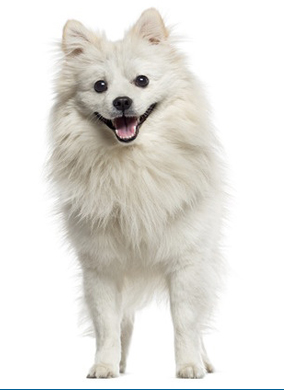
Originally a variety of German Spitz, the American Eskimo dog shares the same history and lineages as the German Spitz varieties that include the Keeshond, Pomeranian, and Volpino Italiano. The German Spitz breed varieties were primarily used as guard dogs and given the task of watching over their people and property. Although the breed is not overly aggressive, German Spitz dogs are known to be hyper-vigilant and vocal, alerting to strangers or passers-by. The Spitz breed has always been divided according to size and color in their native homeland of Germany, a practice that continues to this day. The original recognized German Spitz breed includes the modern-day Wolfspitz (or Keeshond), Gross Spitz (Giant Spitz), Mittelspitz (Medium Spitz), Kleinspitz (Small Spitz), and the smallest German Spitz, the Zwergspitz (Dwarf Spitz)—also known as the Pomeranian. White was not considered an ideal color for the German Spitz breed in its homeland and was therefore not included in the originally recognized color variety options, although the white coloration was neither uncommon nor rare. When the first German Spitz dogs were introduced to the United States in the early 1900s, the white coloration was appreciated and preferred over other colors so much that breeders began selecting for it. The white German Spitz’s beautiful coat, sociable nature, and highly trainable intelligence launched the breed into stardom not just as a companion animal but also as a staple of the circus circuit. One very famous white Spitz named Stout’s Pal Pierre actually walked a tightrope in the Ringling Bros. and Barnum & Bailey Circus. The breed was still known worldwide as the German Spitz up until 1917, at which point the breed was renamed and recognized as the American Eskimo Spitz. It is believed that breeders deliberately chose the new name to avoid any claims of anti-patriotism during World War I. Today, the American Eskimo Spitz is still seen as the German Spitz throughout much of the world, including Germany and much of Europe. For this reason, many breeding programs continue to cross the white American Eskimo with the German Spitz to increase genetic diversity. In the same manner that the German Spitz is divided according to size, the American Spitz also has several sizes, including Standard, Miniature, and Toy varieties.
View Full Breed Standard
 Quick Facts

Group
Spitz and Nordic Breeds

Life Expectancy
12 - 15 years

Coat Type
Medium-length stand-off coat

Origin
UNITED STATES

Weight
6-10 lbs 6-10 lbs

Height
9-12 in 9-12 in
 Breed Ratings
How They Compare
Breed Ratings
How They Compare

Find Toy American Eskimo Puppies
Search our CKC registered breeders to find your new best friend!
 Breed History
Tails of Time
Breed History
Tails of Time
Originally a variety of German Spitz, the American Eskimo dog shares the same history and lineages as the German Spitz varieties that include the Keeshond, Pomeranian, and Volpino Italiano. The German Spitz breed varieties were primarily used as guard dogs and given the task of watching over their people and property. Although the breed is not overly aggressive, German Spitz dogs are known to be hyper-vigilant and vocal, alerting to strangers or passers-by. The Spitz breed has always been divided according to size and color in their native homeland of Germany, a practice that continues to this day. The original recognized German Spitz breed includes the modern-day Wolfspitz (or Keeshond), Gross Spitz (Giant Spitz), Mittelspitz (Medium Spitz), Kleinspitz (Small Spitz), and the smallest German Spitz, the Zwergspitz (Dwarf Spitz)—also known as the Pomeranian. White was not considered an ideal color for the German Spitz breed in its homeland and was therefore not included in the originally recognized color variety options, although the white coloration was neither uncommon nor rare.
When the first German Spitz dogs were introduced to the United States in the early 1900s, the white coloration was appreciated and preferred over other colors so much that breeders began selecting for it. The white German Spitz’s beautiful coat, sociable nature, and highly trainable intelligence launched the breed into stardom not just as a companion animal but also as a staple of the circus circuit. One very famous white Spitz named Stout’s Pal Pierre actually walked a tightrope in the Ringling Bros. and Barnum & Bailey Circus.
The breed was still known worldwide as the German Spitz up until 1917, at which point the breed was renamed and recognized as the American Eskimo Spitz. It is believed that breeders deliberately chose the new name to avoid any claims of anti-patriotism during World War I. Today, the American Eskimo Spitz is still seen as the German Spitz throughout much of the world, including Germany and much of Europe. For this reason, many breeding programs continue to cross the white American Eskimo with the German Spitz to increase genetic diversity. In the same manner that the German Spitz is divided according to size, the American Spitz also has several sizes, including Standard, Miniature, and Toy varieties.
 Breed Standard
Official CKC Standards
Breed Standard
Official CKC Standards
Toy American Eskimo
Breed Group 2: Spitz and Nordic Breeds
Breed Name Aliases
Toy Eski, Toy American Spitz, American Eskimo Spitz, Eskimo Spitz, American Deutscher Spitz
Proportions:
The American Eskimo Spitz is a slightly off-square to a somewhat rectangular dog. From the point of the shoulder to the point of the rump is equal to the height at the withers. The length of the body measured from the point of the forechest to the point of the rump is just greater than the height at the withers with a preferred ratio of 4:5 or 9:10. Females may be slightly longer. The body is well-put together. The substance is sturdy and medium-boned. Males should appear masculine, being more substantial in size and mass, while females should appear more feminine and slightly less substantial. Neither should lack overall type.
Head
- General Appearance: Mesaticephalic skull-type, moderate in size, wedge-shaped, and in proportion to the rest of the body. The topskull is the widest between the ears, being as wide (from one side to the other measured in front of the ears) as it is long (from occiput to stop). In the profile or from the front, it appears slightly arched. The head is clean-cut without excess skin or wrinkles.
- Expression: The expression is engaging, intelligent, and lively.
- Stop: The stop is definite yet not overly abrupt to detract from the wedge-shaped head
-
Skull:
The ideal muzzle-to-skull ratio can range from 1:1 to 2:3, being equal in proportions, or with the topskull being just longer than the muzzle.
The ideal muzzle-to-skull axis is either parallel or slightly convergent. - Muzzle: Equal to or shorter than the topskull. The muzzle is full, deep, and broad. The muzzle is broad and tapers gently toward the nose. The upper and lower jaws have good bone substance. Upper and lower jaws are strong and well-developed, never appearing snipey or weak.
- Lips or Flews: Lips are clean and fit tightly over the teeth and jaws.
- Nose: Lips are clean and fit tightly over the teeth and jaws.
- Cheeks: The cheeks may be flat or exhibit some slight padding. Cheeks should not appear chiseled or coarse.
- Dentition and Bite: Forty-two strong, clean, and white teeth. The bite may be level or scissor. Contact must be made between the top and bottom incisors.
- Eyes: The eyes are medium in size, set well apart, and medium to dark brown in color. They may be almond or oval in shape with tight-fitting eye rims that are pigmented black or dark brown. The eyes are never bulging. There should be sufficient bone in the surrounding orbital sockets to protect the eyes. Dogs should not be penalized for tear stains unless tear stains are indicative of an underlying problem.
- Ears: The ears are proportionate to the head, triangular in shape, and firmly erect. They are set high and well apart. The ears are never long, overly large, or broken.
Body and Tail
- General Description: Compact, solid, and good substance. The body is never racy, refined, long, or cobby. The width at the forequarters is approximately equal to the width at the hindquarters.
- Neck: Moderate length allows for a proud head carriage strongly muscled with a slight arch. The neck tapers smoothly from the deeper and broader body toward the head. The neck is clean-cut and without excess skin, throatiness, or dewlap.
- Chest: Deep and broad, but never wider than deep. The brisket extends to the point of the elbows.
-
Topline:
Level from prominent withers to tail. The back is broad, well-muscled, and straight, yet supple. The loin is taut, flat, and level. The topline is never swayed or roached.
- Croup: Flat and level with the back or gently sloped.
- Underline: A slight tuck-up starting from behind the ribs may be present. The underline is taut and firm, without any indication of sagging or excess weight.
- Ribs: Long, well-sprung, well-laid back, and oval-shaped, never barrel-chested or slab-sided.
- Tail: Set high on the croup, thick at the base and tapering toward the tip. The tail may be carried over the back when moving or alert, or it may be carried downward in a natural position (never tucked) when in repose. The tail is of a medium length, with the tip of the last vertebrae extending to the hock joints when held down. The tail may be straight or gently curved.
Forequarters and Hindquarters
- Forequarters: The forequarters are always in balance with the hindquarters. They are well-angulated with well-laid-back shoulder blades. Shoulder blades are approximately equal in length to the upper arm and forearm.
- Elbows: Elbows are close to the body. The point of the elbows is approximately half the dog’s height at the withers.
-
Forelegs:
Frontal View: Straight, of good muscle and bone, and parallel to one another.
Side View: The forelimbs appear straight with strong pasterns.
- Pasterns: Never weak or broken.
-
Hindquarters:
The upper thigh and lower thigh are equal in length, strong, sturdy, of good bone, and well-muscled.
Rear View: When viewed from the rear, the rear pasterns are parallel to one another.
Side View: Good angulation will allow the rear toes to align with the point of the rump or within one to two paw-lengths behind the point of the rump, with the rear pasterns remaining perpendicular to the ground and parallel to one another. - Stifle Joint: Well-angulated with a good bend to well-let-down rear pasterns.
- Stifle Joint: The angulation of the hindquarters is always in balance with the angulation of the forequarters.
- Feet: Oval to round and compact, with well-arched toes and tough pads.
Coat
- Skin: Well-fitted, yet supple. The skin should never obstruct the outline of the dog.
- Coat Type: Long, straight outer coat, free of any wave, with thick, dense, short undercoat. A thicker main and neck ruff is present. Front of legs covered with shorter smooth hair, back sides of legs, rump, well-feathered with trousers, tail richly plumed. It’s important to note that there is no preference in coat length, and coat length may vary from dog to dog, so long as the coat doesn’t appear sparse or overly abundant.
- Coat Color or Pattern: Solid white or white with tinges of cream, biscuit, or ivory.
Movement
The movement is energetic, agile, effortless, and efficient. The characteristics of a healthy structure are evident. When moving away, the forelegs and rear pasterns should remain parallel to one another. When viewing movement from the front, the forelegs should remain parallel, with elbows and paws moving neither in nor out. From the rear, the back pads should be visible when the rear legs are extended. As speed increases, the forelimbs and hindlimbs will converge to the center line of gravity. From the side, the topline should remain firm and level. Good reach of movement in the front allows the forepaw to extend out in line with the nose. The width between the forefeet when extended should be approximately equal to the width between the hindfeet when extended, indicating balance, good reach, and a good drive. Dogs that exhibit any sign of breathing or locomotive difficulty shall be disqualified from the show ring.
Temperament
The American Eskimo’s endearing temperament makes him one of the most popular Spitz breeds. They are intelligent, keen, watchful, alert, and devoted to their family. They will sound an alarm bark at the sight or sound of any strange person. They are also capable of learning many tasks, tricks, and disciplines, including agility, obedience, and search and rescue. Adult individuals may become reserved or indifferent toward people outside their family, but this should not be considered a fault in a dog. Any unprovoked aggressive or fearful behavior toward people is incorrect for this breed.
Faults
All dogs should be in proper healthy condition, free from disease or defect. Any departure from this description is considered a fault. Unless altered, all male dogs should have two fully descended testicles.

Take our Dog Breed Match Quiz!
What is the best dog breed for you? Take our quiz!