
meet the... Miniature Bull Terrier
In the nineteenth century, the Bull and Terrier, a cross between a number of British Terrier breeds and the now-extinct Old English Bulldog, ancestor to the Bull Terrier, rose to prominence as a breed primarily suited for three bloody tasks: pest control, dog fighting, and bull-baiting. Typically, a bull-baiting setup consisted of a bull being attached to a stake via nine meters of rope, inside of a rope enclosure. The goal of the Bull and Terrier was to incapacitate the creature by scoring successful and sustained bites on the bull's snout, one of the bull’s most sensitive areas. If the dog hoped to survive the encounter, he needed to steadily advance while keeping as low to the ground as possible. As long as the dog stayed close to the ground, as he was trained to do, he could move closer toward the bull while avoiding its horns. The term “Go low, pin, and hold!” referred to the actions the dog had to take to survive his encounter with a bull, since the dog's ability to hold on to the bull's snout often meant the difference between life and death. Sadly, a large number of bull and terriers were severely injured or killed while participating in the bull-baiting, with many breaking bones and losing limbs. It was not until the passing of the Cruelty to Animals Act of 1835 that the blood sport was made illegal in the United Kingdom. Bred with an emphasis placed on functionality over appearance, the Bull and Terrier was meant to combine the tenacity and hardiness of the Old English Bulldog with the agility and intelligence of a Terrier. Many owners bred the dogs strictly for fighting purposes, and, with none of the owners seeking to preserve the original Bull and Terrier breed type, the Bull and Terrier eventually gave way to its descendants: the Bull Terrier and the Staffordshire Bull Terrier. Near the middle of the nineteenth century, James Hinks, of Birmingham, England, crossed a Bull and Terrier with an English White Terrier. He aimed to give more attention to improving the offspring’s appearance than Bull and Terrier breeders of the past, who tended to focus solely on honing the dog's fighting capabilities. Hinks's goals were to lengthen the head of the dog, straighten its crooked front legs, and to make its body balanced and proportional. The end result of Hinks's work was an all-white breed with enough unique features to distinguish it from its progenitor, the Bull and Terrier. Though the dog still lacked its iconic, egg-shaped head, Hinks had effectively created a one-of-a-kind Bull Terrier. In 1862, Hinks entered his female Bull Terrier, Puss, into “The Exhibition of Fancy and Other Dogs” at the Holborn Repository. Puss was sired by Madman, an award-winning white Bulldog owned by Hinks, and she continued in her father's footsteps by winning first prize in the exhibition's Bull Terrier category. According to some accounts, Hinks entered Puss into a fight against another dog in the early 1860s. Allegedly, the dog's owner complained that Hinks's efforts to create a beautiful bull terrier came at the cost of eliminating the fighting spirit of the bull and terrier. Though the other dog in the story is sometimes described as a Bull Terrier or Pit Bull, and the details of the wager change from one account to the next, Puss always manages to best her opponent and prove that she has the fighting abilities of her ancestors, only suffering slight cosmetic injuries during the fight, if any at all. However, the truthfulness of the tale is often called into question due to a number of discrepancies and factual errors found in different versions of the story, including the version provided by Hinks's own biographer, Kevin Kane. Hinks continued his attempts to improve the features of the Bull Terrier. He introduced more diversity into the breed by including aspects of the Dalmatian, Spanish Pointer, Greyhound, Foxhound, Whippet, Borzoi, and Collie. The Borzoi and Collie lengthened the Bull Terrier's head and reduced its brow-to
View Full Breed Standard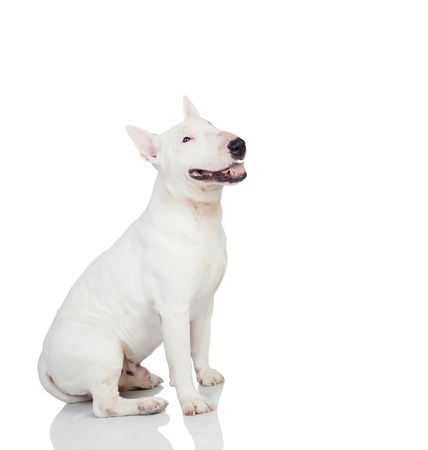
In the nineteenth century, the Bull and Terrier, a cross between a number of British Terrier breeds and the now-extinct Old English Bulldog, ancestor to the Bull Terrier, rose to prominence as a breed primarily suited for three bloody tasks: pest control, dog fighting, and bull-baiting. Typically, a bull-baiting setup consisted of a bull being attached to a stake via nine meters of rope, inside of a rope enclosure. The goal of the Bull and Terrier was to incapacitate the creature by scoring successful and sustained bites on the bull's snout, one of the bull’s most sensitive areas. If the dog hoped to survive the encounter, he needed to steadily advance while keeping as low to the ground as possible. As long as the dog stayed close to the ground, as he was trained to do, he could move closer toward the bull while avoiding its horns. The term “Go low, pin, and hold!” referred to the actions the dog had to take to survive his encounter with a bull, since the dog's ability to hold on to the bull's snout often meant the difference between life and death. Sadly, a large number of bull and terriers were severely injured or killed while participating in the bull-baiting, with many breaking bones and losing limbs. It was not until the passing of the Cruelty to Animals Act of 1835 that the blood sport was made illegal in the United Kingdom. Bred with an emphasis placed on functionality over appearance, the Bull and Terrier was meant to combine the tenacity and hardiness of the Old English Bulldog with the agility and intelligence of a Terrier. Many owners bred the dogs strictly for fighting purposes, and, with none of the owners seeking to preserve the original Bull and Terrier breed type, the Bull and Terrier eventually gave way to its descendants: the Bull Terrier and the Staffordshire Bull Terrier. Near the middle of the nineteenth century, James Hinks, of Birmingham, England, crossed a Bull and Terrier with an English White Terrier. He aimed to give more attention to improving the offspring’s appearance than Bull and Terrier breeders of the past, who tended to focus solely on honing the dog's fighting capabilities. Hinks's goals were to lengthen the head of the dog, straighten its crooked front legs, and to make its body balanced and proportional. The end result of Hinks's work was an all-white breed with enough unique features to distinguish it from its progenitor, the Bull and Terrier. Though the dog still lacked its iconic, egg-shaped head, Hinks had effectively created a one-of-a-kind Bull Terrier. In 1862, Hinks entered his female Bull Terrier, Puss, into “The Exhibition of Fancy and Other Dogs” at the Holborn Repository. Puss was sired by Madman, an award-winning white Bulldog owned by Hinks, and she continued in her father's footsteps by winning first prize in the exhibition's Bull Terrier category. According to some accounts, Hinks entered Puss into a fight against another dog in the early 1860s. Allegedly, the dog's owner complained that Hinks's efforts to create a beautiful bull terrier came at the cost of eliminating the fighting spirit of the bull and terrier. Though the other dog in the story is sometimes described as a Bull Terrier or Pit Bull, and the details of the wager change from one account to the next, Puss always manages to best her opponent and prove that she has the fighting abilities of her ancestors, only suffering slight cosmetic injuries during the fight, if any at all. However, the truthfulness of the tale is often called into question due to a number of discrepancies and factual errors found in different versions of the story, including the version provided by Hinks's own biographer, Kevin Kane. Hinks continued his attempts to improve the features of the Bull Terrier. He introduced more diversity into the breed by including aspects of the Dalmatian, Spanish Pointer, Greyhound, Foxhound, Whippet, Borzoi, and Collie. The Borzoi and Collie lengthened the Bull Terrier's head and reduced its brow-to
View Full Breed Standard
 Quick Facts

Group
Bull Breeds

Life Expectancy
10 - 14 years

Coat Type
Close coat

Origin
ENGLAND

Weight
25-35 lbs 25-35 lbs

Height
10-14 in 10-14 in
 Breed Ratings
How They Compare
Breed Ratings
How They Compare

Find Miniature Bull Terrier Puppies
Search our CKC registered breeders to find your new best friend!
 Breed History
Tails of Time
Breed History
Tails of Time
In the nineteenth century, the Bull and Terrier, a cross between a number of British Terrier breeds and the now-extinct Old English Bulldog, ancestor to the Bull Terrier, rose to prominence as a breed primarily suited for three bloody tasks: pest control, dog fighting, and bull-baiting. Typically, a bull-baiting setup consisted of a bull being attached to a stake via nine meters of rope, inside of a rope enclosure. The goal of the Bull and Terrier was to incapacitate the creature by scoring successful and sustained bites on the bull's snout, one of the bull’s most sensitive areas. If the dog hoped to survive the encounter, he needed to steadily advance while keeping as low to the ground as possible. As long as the dog stayed close to the ground, as he was trained to do, he could move closer toward the bull while avoiding its horns. The term “Go low, pin, and hold!” referred to the actions the dog had to take to survive his encounter with a bull, since the dog's ability to hold on to the bull's snout often meant the difference between life and death.
Sadly, a large number of bull and terriers were severely injured or killed while participating in the bull-baiting, with many breaking bones and losing limbs. It was not until the passing of the Cruelty to Animals Act of 1835 that the blood sport was made illegal in the United Kingdom.
Bred with an emphasis placed on functionality over appearance, the Bull and Terrier was meant to combine the tenacity and hardiness of the Old English Bulldog with the agility and intelligence of a Terrier. Many owners bred the dogs strictly for fighting purposes, and, with none of the owners seeking to preserve the original Bull and Terrier breed type, the Bull and Terrier eventually gave way to its descendants: the Bull Terrier and the Staffordshire Bull Terrier.
Near the middle of the nineteenth century, James Hinks, of Birmingham, England, crossed a Bull and Terrier with an English White Terrier. He aimed to give more attention to improving the offspring’s appearance than Bull and Terrier breeders of the past, who tended to focus solely on honing the dog's fighting capabilities. Hinks's goals were to lengthen the head of the dog, straighten its crooked front legs, and to make its body balanced and proportional. The end result of Hinks's work was an all-white breed with enough unique features to distinguish it from its progenitor, the Bull and Terrier. Though the dog still lacked its iconic, egg-shaped head, Hinks had effectively created a one-of-a-kind Bull Terrier. In 1862, Hinks entered his female Bull Terrier, Puss, into “The Exhibition of Fancy and Other Dogs” at the Holborn Repository. Puss was sired by Madman, an award-winning white Bulldog owned by Hinks, and she continued in her father's footsteps by winning first prize in the exhibition's Bull Terrier category.
According to some accounts, Hinks entered Puss into a fight against another dog in the early 1860s. Allegedly, the dog's owner complained that Hinks's efforts to create a beautiful bull terrier came at the cost of eliminating the fighting spirit of the bull and terrier. Though the other dog in the story is sometimes described as a Bull Terrier or Pit Bull, and the details of the wager change from one account to the next, Puss always manages to best her opponent and prove that she has the fighting abilities of her ancestors, only suffering slight cosmetic injuries during the fight, if any at all. However, the truthfulness of the tale is often called into question due to a number of discrepancies and factual errors found in different versions of the story, including the version provided by Hinks's own biographer, Kevin Kane.
Hinks continued his attempts to improve the features of the Bull Terrier. He introduced more diversity into the breed by including aspects of the Dalmatian, Spanish Pointer, Greyhound, Foxhound, Whippet, Borzoi, and Collie. The Borzoi and Collie lengthened the Bull Terrier's head and reduced its brow-to
 Breed Standard
Official CKC Standards
Breed Standard
Official CKC Standards
Miniature Bull Terrier
Breed Group 4: Bull Breeds
Breed Name Aliases
Miniature English Bull Terrier, Mini Bull Terrier
Proportions:
The Bull Terrier is a slightly rectangular breed with the body length, measured from the prosternum to the point of the rump being just slightly longer than the height at the withers. The ideal body length to height ratio is between 10:9 and 5:4. He is muscular and strongly built, but also agile, energetic, and quick. He should never appear heavy and cumbersome, nor light and racy. The body is well-put together with sturdy substance and medium boned.
Head
-
General Appearance:
GENERAL APPEARANCE: The head is a unique characteristic of the Bull Terrier breed and CKC recognizes two varieties of the head type: the typical type and the terrier type. Both types are well-filled, well-muscled, of good substance, and clean-cut, without wrinkle or excess skin.
Typical Bull Terrier Head: The head is of moderate size and in proportion to the body. It is somewhat dolichocephalic, with the domed shape skull being characteristically associated with the Bull Terrier breed. As opposed to most other breeds that exhibit a discernible stop, the typical Bull Terrier breed exhibits no discernible stop. The head is long, broad, deep, somewhat sloped, with diverging planes of the skull and muzzle. The face is well-muscled and well-filled, adding to the egg-like appearance of the head. The topskull and forehead are broad and flat, and in profile the forehead slopes slightly downward. The head should never appear weak, narrow, snipy, hollowed, or chiseled.
Terrier Head: The head is of moderate size and in proportion to the body. It is a less exaggerated dolichocephalic version of the typical head. The head is slightly less dome-shaped and exhibits a slight, yet perceptible, dip in the profile where the stop is located. Like the typical head, the Terrier head is long, broad, deep, but the muzzle is slightly less Roman-shaped, or sloped. The planes of the skull and muzzle may run almost parallel rather than diverging. The face is well-muscled and well-filled. The topskull and forehead are broad and flat, and in profile the forehead slopes slightly downward. The head should never appear weak, narrow, snipy, hollowed, or chiseled.
- Expression: Intelligent, anticipatory, keen, watchful, engaged, lively, and intelligent.
- Stop: Terrier Head: A slight but perceptible dip is located on the plane of the head level with the corners of the eyes.
-
Skull:
The ideal muzzle-to-skull ratio is approximately 1:1, or 5:4, with the muzzle being just longer than the topskull.
Typical Bull Terrier Head: The ideal muzzle-to-skull axis is divergent, giving the profile of the head a smooth, somewhat arched appearance.
Terrier Head: The ideal muzzle-to-skull axis is may be slightly divergent, or may run almost parallel.
- Muzzle: May be equal to or just slightly longer than the topskull. It is broad, deep, full, and well-developed. It should remain broad from the base to the end, without tapering to a point, but ending rather bluntly. The face should be sufficiently filled under the eyes, adding to the broad appearance of the face. The upper and lower jaws are very strongly developed.
- Lips or Flews: Lips are clean and fit tightly over the teeth and jaws.
- Nose: The nose is well-pigmented and black, or self-colored in non-standard varieties. The nostrils are well-opened.
- Cheeks: The cheeks are well-developed and fill the face well, but should not appear overly bulky, nor should the cheeks appear flat, hollow, or chiseled.
- Dentition and Bite: Forty-two strong, clean, white teeth. Bite may be level or scissor. Contact must be made between the top and bottom incisors. Missing or broken teeth as a result of routine work is not to be penalized.
- Eyes: The eyes are of a moderate size, set well in the skull and well apart. They may be triangular, diamond, or almond in shape. They are obliquely set. Due to the longer muzzle and shorter skull, the eyes appear set somewhat high on the face. They can range in color from medium to dark brown. Non-standard color varieties may also include amber, green, or hazel. The eye rims are tightly fitted without exposed whites or haw.
- Ears: Rather small in size, set high on the skull, and held firmly erect. When the dog is alert, the tips of the ears point straight up. They are very mobile.
Body and Tail
- General Description: Deep, broad, solid, well-knit, compact, and of good substance. The body is never racy or refined. Width at forequarters is somewhat broad, but never heavy, with forequarters being approximately equal to the width at the hindquarters. The body denotes power and agility.
- Neck: Moderate length to allow for proud head carriage and strongly muscled, with a slight arch. The neck tapers smoothly from the deeper and broader body toward the head. The neck is clean-cut, without excess skin, throatiness, or dewlap.
- Chest: Deep, broad, but never wider than deep. The brisket extends to the point of the elbows.
- Topline: Level from withers to croup. The back is broad, strongly muscled, straight, supple, and somewhat short. The loin is taut, flat, and level, or slightly (almost imperceptibly) arched, yet supportive. The topline is never swayed or roached.
- Croup: Broad and gently sloped.
- Underline: A slight tuck up is present, or the underline may run parallel to the topline. The underline is taut and firm, without any indication of sagging or excess weight.
- Ribs: Long, well-sprung, well-laid-back, oval-shaped, never barrel-chested or slab-sided.
- Tail: Set somewhat low on the croup, thick at the base, and tapering toward the tip. Carried in accordance with the dog’s mood and energy level, but never tucked or carried up over the back. When in repose, the tail may be held downward in a neutral position. When active, the tail may be carried straight outward or slightly above the level of the topline. Tail is of a medium length, with the tip of the last vertebrae extending to the hock joints when held down. The tail may be straight or gently curved.
Forequarters and Hindquarters
- Forequarters: Forequarters are always in balance with the hindquarters. Forequarters are well-angulated with well-laid-back shoulder blades. Shoulder blades are approximately equal in length to the upper arm and forearm. Some specimens may exhibit a slightly shorter upper arm, which is not to be penalized.
- Elbows: Elbows are close to the body. The point of the elbows is approximately half the dog’s height at the withers.
-
Forelegs:
Frontal View: Straight, of good muscle and bone, and parallel to one another.
Side View: The forelimbs appear straight with strong pasterns.
- Pasterns: Never weak or broken.
-
Hindquarters:
Upper thigh and lower thigh are equal in length, strong, sturdy, of good bone, and well-muscled.
Rear View: When viewed from the rear, the rear pasterns are parallel to one another.
Side View: Good angulation will allow the rear toes to align with the point of the rump or within one to two paw-lengths behind the point of the rump, with the rear pasterns remaining perpendicular to the ground and parallel to one another.
- Stifle Joint: Well-angulated with a good bend to well-let-down rear pasterns.
- Stifle Joint: Angulation of hindquarters is always in balance with angulation of forequarters.
- Feet: Oval to round, compact, with well-arched toes and tough pads.
Coat
- Skin: Well-fitted, yet supple. The skin should never obstruct the outline of the dog.
- Coat Type: Short, flat, glossy, outer coat that is harsh to the touch, with or without seasonal soft undercoat.
-
Coat Color or Pattern:
CKC recognizes two color varieties of the Bull Terrier breed: the standard color and nonstandard color variety.
Standard Coat Color Variety: Various shades of brindle, red, fawn (with or without mask), sable, smut, and tricolor (black with tan points). All with or without varying degrees of white.
Solid white: Solid white with no other color markings on the coat.
White Irish spotting: White designated to the paws and lower legs, chest, neck, and tail tip. Muzzle and blaze may be present.
Pied: White present in patches throughout the body.
Color-headed white: Color restricted to just the head, and perhaps one or two patches on the body.
Non-Standard Coat Color Variety: Various shades of blue, or liver, with or without tan points, blue or liver brindle, blue or liver fawn or smut, blue or liver sable, all with or without varying amounts of white or ticking,
Solid white: Solid white with no other color markings on the coat.
White Irish spotting: White designated to the paws and lower legs, chest, neck, and tail tip. Muzzle and blaze may be present.
Pied: White present in patches throughout the body.
Color-headed white: Color restricted to just the head, and perhaps one or two patches on the body.
Movement
The Bull Terrier’s movement is jaunty, lively, energetic, efficient, and effortless. The characteristics of healthy structure are evident: when moving away, the forelegs and rear pasterns should remain parallel to one another. When viewing movement from the front, the forelegs should remain parallel, with elbows and paws moving neither in nor out. From the rear, the back pads should be visible when the rear legs are extended. As speed increases, the forelimbs and hindlimbs will converge to the center line of gravity. From the side, the topline should remain firm and level. Good reach of movement in the front allows the forepaw to extend out in a line with the nose. The width between the forefeet when extended should be approximately equal to the width between the hindfeet when extended, indicating balance, good reach, and good drive. Dogs that exhibit any sign of breathing or locomotive difficulty shall be disqualified from the show ring.
Temperament
The Bull Terrier is renowned for his excellent disposition, even temper, and friendly nature. He is confident, self-composed, outgoing, and watchful. Although engaging and people-oriented, many Bull Terriers are quite independent—a trait that some misinterpret as stubbornness. He is intelligent, eager to learn (with the right motivation), and capable of learning many disciplines and tricks. Any unprovoked aggressive or fearful behavior toward people is incorrect for this breed.
Faults
All dogs should be in proper healthy condition, free from disease or defect. Any departure from this description is considered a fault. Unless altered, all male dogs should have two fully descended testicles.

Take our Dog Breed Match Quiz!
What is the best dog breed for you? Take our quiz!