
meet the... Keeshond
The German Spitz breeds are the oldest European Spitz breeds. Many believe that these dogs are descended from the ancient Torfhund, also called Torfspitz, or peat dogs found throughout Europe, Asia, and Africa. These Spitz-type dogs were believed to have played a key role in the domestication of the dog. The ancestors of the German Spitz dogs were primarily used as guard dogs and were given the task of watching over their people and property for centuries in areas throughout Germany. Although not overly aggressive, they are known to be hyper-vigilant, vocal, and alert to strangers or passersby. The Spitz breed has always been divided according to size and color in their native homeland of Germany, and this is still true today. The original recognized German Spitz breed includes the modern-day Wolfspitz, also called the Keeshond in the Netherlands, the Gross (Giant) Spitz, Mittelspitz (Medium Spitz), Kleinspitz (Small Spitz), and the smallest German Spitz, the Zwergspitz (Dwarf Spitz), or as we know it, the Pomeranian. The Dutch favored the larger wolf-gray variety of the Spitz breed. He was known in Holland for centuries as a barge guard, farm watchdog, and household companion. The political discord of the late 1700s provided fertile soil for sprouting revolutions—from the American Revolution to the French Revolution. The Netherlands experienced its own version of revolution in the late 18th century. Two opposing parties emerged in Holland at the time: Prince of Orange loyalists, known as prinsgezinden, and the patriots, or patriotten. Cornelis “Kees” de Gijselaar, a leader of the Dutch Patriots party, owned a Spitz-like dog that became the rebels’ symbol, generating the breed’s popularity with Holland’s commoners. The name Keeshond (pronounced KAYZ-hahnd) is a combination of Gijselaar’s nickname “Kees” and hond, the Dutch word for dog. The Keeshond breed lost recognition after the revolution’s end when the Prince of Orange overthrew the Dutch Patriots. Many Keeshonden (the plural form of Keeshond) were destroyed because of their association with the rebel party. The surviving Keeshonden worked on barges and farms. The Keeshond eventually fell out of popularity and into obscurity for over a hundred years. Around the 1920s, the Keeshond was revived by Baroness van Hardenbroek in 1920, and his popularity began to spread, first to England thanks in part to Mrs. Wingfield-Digby, and then to America. The breed’s name was officially changed from German Spitz or Wolfspitz to Keeshond in England in 1926. In foreign organizations, like the Federation Cynologique International, they are considered all the same breed, just a different variety. However, in the United States, they are often considered a separate breed. Today, the Keeshond is one of the most popular varieties of the German Spitz varieties.
View Full Breed Standard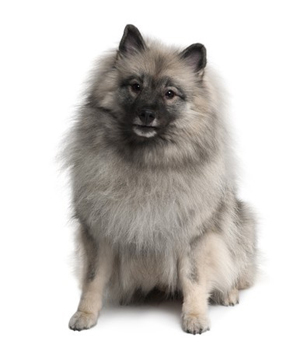
The German Spitz breeds are the oldest European Spitz breeds. Many believe that these dogs are descended from the ancient Torfhund, also called Torfspitz, or peat dogs found throughout Europe, Asia, and Africa. These Spitz-type dogs were believed to have played a key role in the domestication of the dog. The ancestors of the German Spitz dogs were primarily used as guard dogs and were given the task of watching over their people and property for centuries in areas throughout Germany. Although not overly aggressive, they are known to be hyper-vigilant, vocal, and alert to strangers or passersby. The Spitz breed has always been divided according to size and color in their native homeland of Germany, and this is still true today. The original recognized German Spitz breed includes the modern-day Wolfspitz, also called the Keeshond in the Netherlands, the Gross (Giant) Spitz, Mittelspitz (Medium Spitz), Kleinspitz (Small Spitz), and the smallest German Spitz, the Zwergspitz (Dwarf Spitz), or as we know it, the Pomeranian. The Dutch favored the larger wolf-gray variety of the Spitz breed. He was known in Holland for centuries as a barge guard, farm watchdog, and household companion. The political discord of the late 1700s provided fertile soil for sprouting revolutions—from the American Revolution to the French Revolution. The Netherlands experienced its own version of revolution in the late 18th century. Two opposing parties emerged in Holland at the time: Prince of Orange loyalists, known as prinsgezinden, and the patriots, or patriotten. Cornelis “Kees” de Gijselaar, a leader of the Dutch Patriots party, owned a Spitz-like dog that became the rebels’ symbol, generating the breed’s popularity with Holland’s commoners. The name Keeshond (pronounced KAYZ-hahnd) is a combination of Gijselaar’s nickname “Kees” and hond, the Dutch word for dog. The Keeshond breed lost recognition after the revolution’s end when the Prince of Orange overthrew the Dutch Patriots. Many Keeshonden (the plural form of Keeshond) were destroyed because of their association with the rebel party. The surviving Keeshonden worked on barges and farms. The Keeshond eventually fell out of popularity and into obscurity for over a hundred years. Around the 1920s, the Keeshond was revived by Baroness van Hardenbroek in 1920, and his popularity began to spread, first to England thanks in part to Mrs. Wingfield-Digby, and then to America. The breed’s name was officially changed from German Spitz or Wolfspitz to Keeshond in England in 1926. In foreign organizations, like the Federation Cynologique International, they are considered all the same breed, just a different variety. However, in the United States, they are often considered a separate breed. Today, the Keeshond is one of the most popular varieties of the German Spitz varieties.
View Full Breed Standard
 Quick Facts

Group
Spitz and Nordic Breeds

Life Expectancy
12 - 14 years

Coat Type
Long stand-off coat

Origin
GERMANY/NETHERLANDS

Weight
55-66 lbs 55-66 lbs

Height
18-20 in 17-19 in
 Breed Ratings
How They Compare
Breed Ratings
How They Compare

 Breed History
Tails of Time
Breed History
Tails of Time
The German Spitz breeds are the oldest European Spitz breeds. Many believe that these dogs are descended from the ancient Torfhund, also called Torfspitz, or peat dogs found throughout Europe, Asia, and Africa. These Spitz-type dogs were believed to have played a key role in the domestication of the dog. The ancestors of the German Spitz dogs were primarily used as guard dogs and were given the task of watching over their people and property for centuries in areas throughout Germany.
Although not overly aggressive, they are known to be hyper-vigilant, vocal, and alert to strangers or passersby. The Spitz breed has always been divided according to size and color in their native homeland of Germany, and this is still true today. The original recognized German Spitz breed includes the modern-day Wolfspitz, also called the Keeshond in the Netherlands, the Gross (Giant) Spitz, Mittelspitz (Medium Spitz), Kleinspitz (Small Spitz), and the smallest German Spitz, the Zwergspitz (Dwarf Spitz), or as we know it, the Pomeranian.
The Dutch favored the larger wolf-gray variety of the Spitz breed. He was known in Holland for centuries as a barge guard, farm watchdog, and household companion. The political discord of the late 1700s provided fertile soil for sprouting revolutions—from the American Revolution to the French Revolution. The Netherlands experienced its own version of revolution in the late 18th century. Two opposing parties emerged in Holland at the time: Prince of Orange loyalists, known as prinsgezinden, and the patriots, or patriotten. Cornelis “Kees” de Gijselaar, a leader of the Dutch Patriots party, owned a Spitz-like dog that became the rebels’ symbol, generating the breed’s popularity with Holland’s commoners. The name Keeshond (pronounced KAYZ-hahnd) is a combination of Gijselaar’s nickname “Kees” and hond, the Dutch word for dog.
The Keeshond breed lost recognition after the revolution’s end when the Prince of Orange overthrew the Dutch Patriots. Many Keeshonden (the plural form of Keeshond) were destroyed because of their association with the rebel party. The surviving Keeshonden worked on barges and farms. The Keeshond eventually fell out of popularity and into obscurity for over a hundred years. Around the 1920s, the Keeshond was revived by Baroness van Hardenbroek in 1920, and his popularity began to spread, first to England thanks in part to Mrs. Wingfield-Digby, and then to America. The breed’s name was officially changed from German Spitz or Wolfspitz to Keeshond in England in 1926. In foreign organizations, like the Federation Cynologique International, they are considered all the same breed, just a different variety. However, in the United States, they are often considered a separate breed. Today, the Keeshond is one of the most popular varieties of the German Spitz varieties.
 Breed Standard
Official CKC Standards
Breed Standard
Official CKC Standards
Keeshond
Breed Group 2: Spitz and Nordic Breeds
Breed Name Aliases
Wolfsspitz, Kees, Wolfspitz, German Wolfspitz, Keeshond
Proportions:
Square to off-square with the length of the body, measured from the point of the forechest to the point of the rump, being just slightly greater than the height at the withers. The ideal body-height-to-length ratio is between 1:1 and 5:4. The body is well-put-together, with sturdy substance and medium bone. Males should appear masculine, being more substantial in size and mass, while females should appear more feminine and slightly less substantial. Neither should lack overall type. The weight of males or females is always in proportion to height.
GERMAN SPITZ, SMALL
HEIGHT: 9-12 inches
WEIGHT: Up to 10 pounds
GERMAN SPITZ, STANDARD
HEIGHT: 12-17 inches
WEIGHT: 15-35 pounds
GERMAN SPITZ, GIANT
HEIGHT: 17-19 inches
WEIGHT: 38-40 pounds
GERMAN WOLFSPITZ/KEESHOND
HEIGHT: Males: 18-20 inches; Females: 17-19 inches
WEIGHT: Males: 55-66 pounds
Head
- General Appearance: Mesaticephalic skull-type, moderate in size, wedge-shaped, foxlike, and in proportion to the rest of the body. The topskull is fairly broad. The masseter and temporalis muscles are well-developed but not prominent, giving the head and face sufficient substance without appearing coarse or chiseled. The head is clean-cut without excess skin or wrinkles.
- Expression: Alert, watchful, and intelligent. When happy or comfortable, the German Spitz group is known to “smile” and exude a merry expression. The expression of the Wolfspitz (or Keeshond) is a bit more unique and results from a unique combination of facial markings and shadings surrounding the dogs’ eyes. Known as “spectacles,” the markings and shadings form a ring of lighter color around the eyes that are encircled or outlined in a darker line of shaded hairs. This gives a similar appearance to glasses, or spectacles, being drawn on the dog's face. To add to the spectacled appearance, a line of delicately shaded hairs run in a line from the outer corners of the eyes to the inner corners of the ears. These markings are a characteristic element of the Keeshond breed.
- Stop: The stop is moderate to definite but should never appear steep or abrupt.
-
Skull:
The ideal muzzle-to-skull ratio is 3:2, with the topskull being just longer than the muzzle for the Giant Spitz, Wolfspitz, and Keeshond,
The ideal muzzle-to-skull axis is slightly convergent. - Muzzle: The muzzle is full, deep, and broad. The plane, or bridge of the muzzle, is straight. The upper and lower jaws are well-developed, approximately equal in length, have good bone substance, never snipey or weak. The muzzle tapers from the broad base toward the nose, emphasizing the head’s wedge shape.
- Lips or Flews: The lips are clean and fit tightly over the teeth and jaws.
- Nose: The nose is well-pigmented and black. The nostrils are well-opened.
- Cheeks: The cheeks are smoothly muscled and never chiseled or coarse. They blend and taper smoothly toward the muzzle.
- Dentition and Bite: Forty-two strong, clean, and white teeth. The bite may be level, scissor, or reverse-scissor. Contact must be made between the top and bottom incisors. Missing or broken teeth due to routine work are not to be penalized.
- Eyes: Moderate in size, oval to almond in shape, and medium to dark brown in color. The eye rims are well-fitted and well-pigmented. The eyes are never bulging. There should be sufficient bone in the surrounding orbital sockets to protect the eyes. There is sufficient fill below the eyes.
- Ears: Fairly small in size, set high on the skull, and fairly close together. The ears are firmly erect, V-shaped, or triangular, broad at the base, with pointed tips. They are never long, overly large, or broken.
Body and Tail
- General Description: Compact, solid, short-coupled, and of good substance. The body is never racy or refined. The width at the forequarters is approximately equal to the width at the hindquarters.
- Neck: Moderate length allows for proud head carriage. Strongly muscled, with a slight arch. The neck tapers smoothly from the deeper and broader body toward the head. The neck is clean-cut, without excess skin, throatiness, or dewlap.
- Chest: Deep and broad but never wider than deep. The brisket extends to the point of the elbows.
- Topline: May be straight and level or gently sloped, from slightly prominent withers to croup. The back is broad, strongly muscled, and straight, yet supple. The loin is taut, flat, level, or slightly arched, yet supportive. The back is never swayed or roached.
- Croup: Flat and level with the back or gently sloped.
- Underline: A slight tuck-up is present. The underline is taut and firm, without any indication of sagging or excess weight.
- Ribs: Long, well-sprung, well-laid-back, oval-shaped, never barrel-chested or slab-sided.
- Tail: Set high on the croup. It is thick at the base and tapering toward the tip. The tail is carried up and over the back, falling to one side and lying flat against the body. It is never tucked. The tail is of a medium length, with the tip of the last vertebrae extending to the hock joints when held down.
Forequarters and Hindquarters
- Forequarters: The forequarters are always balanced with the hindquarters and well-angulated with well-laid-back shoulder blades. Shoulder blades are approximately equal in length to the upper arm and forearm.
- Elbows: The elbows are close to the body. The point of the elbows is approximately half the dog’s height at the withers.
-
Forelegs:
Frontal View: Straight, of good muscle, moderate bone, and parallel to one another.
Side View: The forelimbs appear straight with strong pasterns.
- Pasterns: Never weak or broken.
-
Hindquarters:
The upper and lower thighs are equal in length, strong, sturdy, of moderate bone, and well-muscled.
Rear View: When viewed from the rear, the rear pasterns are parallel to one another.
Side View: Good angulation will allow the rear toes to align with the point of the rump or within one to two paw-lengths behind the point of the rump, with the rear pasterns remaining perpendicular to the ground and parallel to one another. - Stifle Joint: Well-angulated with a good bend to well-let-down rear pasterns.
- Stifle Joint: The angulation of the hindquarters is always in balance with the angulation of the forequarters.
- Feet: Oval to round, compact, with well-arched toes and tough pads.
Coat
- Skin: Well-fitted, yet supple. The skin should never obstruct the outline of the dog.
- Coat Type: Long, straight, harsh, stand-offish outer coat with a thick mane, frill, well-feathered on the back of legs forming trousers, with a bushy, plumed tail. The coat is short on the head, muzzle, ears, and front of the legs. The undercoat is thick and downy and supports the outer coat.
-
Coat Color or Pattern:
Standard coat color variety: Various shades of agouti, wolf-gray, or wolf-sable; a mixture of gray, black, cream, or tawny. The shades can range from faint to dark, with a contrast between the shades being evident to dramatic. The agouti pattern exhibits cream or tawny banding or highlighting, undertones, and points on gray or black hairs. The German Spitz and Keeshond should always exhibit a characteristic gray or black mask, "spectacles" around the eyes, and cream/silvery “points” on the legs, the rear pasterns, the back of the upper and lower thighs, the base, and underside of the tail, mane, ruff, and shoulder ring. The tail tip is black. Some dogs will exhibit an extended mask, in which the mask extends beyond the face and ears, onto the body, shading the ruff and beyond. This is acceptable.
Non-standard coat color variety: Solid black, liver or liver agouti, solid white or cream, standard or non-standard colors with white markings, black or gray mask extension covering the majority of the body, black or gray more than ½ way down the legs, white or pied markings, excessively pale colored dogs.
Movement
Bold, strong, lively, energetic, and efficient. The characteristics of a healthy structure are evident. When moving away, the forelegs and rear pasterns should remain parallel to one another. When viewing movement from the front, the forelegs should remain parallel, with elbows and paws moving neither in nor out. From the rear, the back pads should be visible when the rear legs are extended. As speed increases, the forelimbs and hindlimbs will converge to the center line of gravity. From the side, the topline should remain firm and level. Good reach of movement in the front allows the forepaw to extend out in line with the nose. When extended, the width between the forefeet should be approximately equal to the width between the hindfeet when extended, indicating balance, good reach, and good drive. Dogs that exhibit any sign of breathing or locomotive difficulty shall be disqualified from the show ring.
Temperament
The Keeshond breed is full of life and loves to play with children. In fact, they make great companions for any member of the family. Smart, alert, and high-spirited, the Keeshond breed are fast learners since they are eager to learn and please their owners. This affectionate dog fits in well as part of the family and is outgoing toward most people as soon as they are sure that their owner approves of that person. Keeshonds also make outstanding watchdogs. Any unprovoked aggressive or fearful behavior toward people is incorrect for this breed.
Faults
All dogs should be in proper healthy condition, free from disease or defect. Any departure from this description is considered a fault. Unless altered, all male dogs should have two fully descended testicles.

Take our Dog Breed Match Quiz!
What is the best dog breed for you? Take our quiz!