
meet the... German Shorthaired Pointer
Many of the details surrounding the German Shorthaired Pointer breed’s origin may have been lost to time, but early versions of the breed have been traced back to the seventeenth century. The modern breed likely descends from the German Bird Dog, a breed that was a mix between the Pachón Navarro (Spanish Pointer) and Bloodhounds. In the late nineteenth century, breeders added various tracking dogs and the English Pointer to the bloodline, expertly melding elegance with efficiency to create the German Shorthaired Pointer. Credited with focusing on the breed’s development in the 1800s, Germany’s Prince Albrecht zu Solms-Braunfels encouraged breeders to cultivate the breed’s functionality as a hunting companion. Breeding for function diversified the dog’s skill set and developed its superior capabilities as a pointer, retriever, tracker, and athlete. Though some gundogs were better suited for specific prey, the German Shorthaired Pointer exercised his versatility, demonstrating the same expert levels of hunting, tracking, and pointing on land as in water. His webbed paws, keen sense of smell, physical wherewithal, and determination outfitted him to hunt birds (including waterfowl) and mammals alike. With his handsome looks and exhaustive catalog of capabilities, the German Shorthaired Pointer exceeded expectations, and nineteenth-century German hunters, realizing the dog’s value, fully recognized the breed. In 1925, Dr. Charles R. Thornton imported the first known German Shorthaired Pointer (a female) into the United States from Austria and bred the dog at his Montana kennel. Within five years, the U.S. officially recognized the German Shorthaired Pointer. World War II forced everyday activities and business into the backseat, including breeding. With the threat of conquest at the war’s end, many German citizens feared the invading Allies would pillage their cities, and some Germans secreted their priceless possessions—jewels, artwork, and champion dogs—from enemy hands. German breeders shipped their finest dogs to the Kingdom of Yugoslavia for protection. However, Yugoslavia joined the Eastern Bloc (transitioning into the Socialist Federal Republic of Yugoslavia) after the war, and the resulting Iron Curtain separated many breeders from their prized dogs. Without access to quality breeding stock, West German breeders struggled to improve the breed with limited resources in the advent of the Cold War. In the United States, however, the future of the German Shorthaired Pointer seemed incredibly bright after World War II. After the breed received full recognition, founding U.S. breeders established the official breed standard. The breed has captured America's attention since its introduction to the United States. Crime novelist Robert B. Parker’s popular Spenser series follows a Boston detective who owns three separate German Shorthaired Pointers named Pearl. An example of art imitating life, Parker's inspiration to include Pearl in his novels came from his own German Shorthaired Pointer, also named Pearl. Writer and environmentalist Rick Bass authored his 2001 book "Colter: The True Story of the Best Dog I Ever Had" as a testament to the beloved breed. Similarly, sportsman and writer Mel Ellis’s hunting experiences with his loyal shorthaired pointer inspired him to write "Run Rainey Run" in 1967.
View Full Breed Standard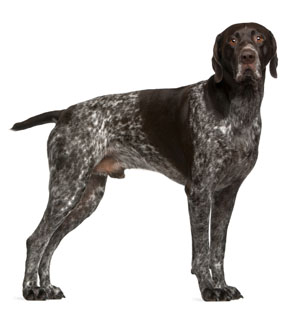
Many of the details surrounding the German Shorthaired Pointer breed’s origin may have been lost to time, but early versions of the breed have been traced back to the seventeenth century. The modern breed likely descends from the German Bird Dog, a breed that was a mix between the Pachón Navarro (Spanish Pointer) and Bloodhounds. In the late nineteenth century, breeders added various tracking dogs and the English Pointer to the bloodline, expertly melding elegance with efficiency to create the German Shorthaired Pointer. Credited with focusing on the breed’s development in the 1800s, Germany’s Prince Albrecht zu Solms-Braunfels encouraged breeders to cultivate the breed’s functionality as a hunting companion. Breeding for function diversified the dog’s skill set and developed its superior capabilities as a pointer, retriever, tracker, and athlete. Though some gundogs were better suited for specific prey, the German Shorthaired Pointer exercised his versatility, demonstrating the same expert levels of hunting, tracking, and pointing on land as in water. His webbed paws, keen sense of smell, physical wherewithal, and determination outfitted him to hunt birds (including waterfowl) and mammals alike. With his handsome looks and exhaustive catalog of capabilities, the German Shorthaired Pointer exceeded expectations, and nineteenth-century German hunters, realizing the dog’s value, fully recognized the breed. In 1925, Dr. Charles R. Thornton imported the first known German Shorthaired Pointer (a female) into the United States from Austria and bred the dog at his Montana kennel. Within five years, the U.S. officially recognized the German Shorthaired Pointer. World War II forced everyday activities and business into the backseat, including breeding. With the threat of conquest at the war’s end, many German citizens feared the invading Allies would pillage their cities, and some Germans secreted their priceless possessions—jewels, artwork, and champion dogs—from enemy hands. German breeders shipped their finest dogs to the Kingdom of Yugoslavia for protection. However, Yugoslavia joined the Eastern Bloc (transitioning into the Socialist Federal Republic of Yugoslavia) after the war, and the resulting Iron Curtain separated many breeders from their prized dogs. Without access to quality breeding stock, West German breeders struggled to improve the breed with limited resources in the advent of the Cold War. In the United States, however, the future of the German Shorthaired Pointer seemed incredibly bright after World War II. After the breed received full recognition, founding U.S. breeders established the official breed standard. The breed has captured America's attention since its introduction to the United States. Crime novelist Robert B. Parker’s popular Spenser series follows a Boston detective who owns three separate German Shorthaired Pointers named Pearl. An example of art imitating life, Parker's inspiration to include Pearl in his novels came from his own German Shorthaired Pointer, also named Pearl. Writer and environmentalist Rick Bass authored his 2001 book "Colter: The True Story of the Best Dog I Ever Had" as a testament to the beloved breed. Similarly, sportsman and writer Mel Ellis’s hunting experiences with his loyal shorthaired pointer inspired him to write "Run Rainey Run" in 1967.
View Full Breed Standard
 Quick Facts

Group
Gun Dog Breeds

Life Expectancy
12 - 15 years

Origin
GERMANY

Weight
55-70 lbs 45-60 lbs

Height
23-26 in 21-25 in
 Breed Infographic Video
All You Need to Know
Breed Infographic Video
All You Need to Know
 Breed Ratings
How They Compare
Breed Ratings
How They Compare

Find German Shorthaired Pointer Puppies
Search our CKC registered breeders to find your new best friend!
 Breed History
Tails of Time
Breed History
Tails of Time
Many of the details surrounding the German Shorthaired Pointer breed’s origin may have been lost to time, but early versions of the breed have been traced back to the seventeenth century. The modern breed likely descends from the German Bird Dog, a breed that was a mix between the Pachón Navarro (Spanish Pointer) and Bloodhounds. In the late nineteenth century, breeders added various tracking dogs and the English Pointer to the bloodline, expertly melding elegance with efficiency to create the German Shorthaired Pointer.
Credited with focusing on the breed’s development in the 1800s, Germany’s Prince Albrecht zu Solms-Braunfels encouraged breeders to cultivate the breed’s functionality as a hunting companion. Breeding for function diversified the dog’s skill set and developed its superior capabilities as a pointer, retriever, tracker, and athlete. Though some gundogs were better suited for specific prey, the German Shorthaired Pointer exercised his versatility, demonstrating the same expert levels of hunting, tracking, and pointing on land as in water. His webbed paws, keen sense of smell, physical wherewithal, and determination outfitted him to hunt birds (including waterfowl) and mammals alike. With his handsome looks and exhaustive catalog of capabilities, the German Shorthaired Pointer exceeded expectations, and nineteenth-century German hunters, realizing the dog’s value, fully recognized the breed.
In 1925, Dr. Charles R. Thornton imported the first known German Shorthaired Pointer (a female) into the United States from Austria and bred the dog at his Montana kennel. Within five years, the U.S. officially recognized the German Shorthaired Pointer.
World War II forced everyday activities and business into the backseat, including breeding. With the threat of conquest at the war’s end, many German citizens feared the invading Allies would pillage their cities, and some Germans secreted their priceless possessions—jewels, artwork, and champion dogs—from enemy hands. German breeders shipped their finest dogs to the Kingdom of Yugoslavia for protection. However, Yugoslavia joined the Eastern Bloc (transitioning into the Socialist Federal Republic of Yugoslavia) after the war, and the resulting Iron Curtain separated many breeders from their prized dogs. Without access to quality breeding stock, West German breeders struggled to improve the breed with limited resources in the advent of the Cold War.
In the United States, however, the future of the German Shorthaired Pointer seemed incredibly bright after World War II. After the breed received full recognition, founding U.S. breeders established the official breed standard.
The breed has captured America's attention since its introduction to the United States. Crime novelist Robert B. Parker’s popular Spenser series follows a Boston detective who owns three separate German Shorthaired Pointers named Pearl. An example of art imitating life, Parker's inspiration to include Pearl in his novels came from his own German Shorthaired Pointer, also named Pearl. Writer and environmentalist Rick Bass authored his 2001 book "Colter: The True Story of the Best Dog I Ever Had" as a testament to the beloved breed. Similarly, sportsman and writer Mel Ellis’s hunting experiences with his loyal shorthaired pointer inspired him to write "Run Rainey Run" in 1967.
 Breed Standard
Official CKC Standards
Breed Standard
Official CKC Standards
German Shorthaired Pointer
Breed Group 11: Gun Dog Breeds
Breed Name Aliases
Deutscher Kurzhaariger Vorstehhund, GSP, Deutsch Kurzhaar, German Shorthair, Braco Aleman De Pelo Corto, Braque Allemand a Poil Court, Deutscher KurzhaariGer, German Short-HaiRed Pointing Dog, Vorstehhund
Proportions:
Square to off-square with the length of the body, measured from the point of the forechest to the point of the rump, being equal to or just slightly greater than the height at the withers. The ideal body height-to-length ratio is between 1:1 and 10:9. Females may be slightly longer. The body is well-put-together, with sturdy substance, and somewhat fine to medium bone, wrapped in hard, sinewy muscle. The GSP is built for speed, agility, and endurance. Males should appear masculine, being more substantial in size and mass, while females should appear more feminine and slightly less substantial. Neither should lack overall type. The weight of males or females is always in proportion to height.
Head
- General Appearance: Mesaticephalic skull-type, moderate in size, wedge-shaped, and in proportion to the rest of the body. It is neither heavy nor light in substance or size. The topskull is moderately broad and slightly arched on the side and top. The occiput is only slightly pronounced. A faint median furrow starts at the stop and disappears toward the occiput. The brows are well-developed. Although lean, the head is powerfully equipped with strong, smooth, well-developed, yet never overly prominent muscle. The head is clean-cut without excess skin or wrinkles.
- Expression: Keen, watchful, sincere, lively, intelligent, and eager.
- Stop: The stop is only moderately defined and should never be definite.
-
Skull:
The ideal muzzle-to-skull ratio is 1:1, with the topskull being equal in length to the muzzle.
The ideal muzzle-to-skull axis is parallel. - Muzzle: Long, broad, deep, full, and strongly developed. The plane of the muzzle may be straight or with a very slight curvature; however, it must never appear concave or dish-faced. The upper and lower jaws are equal in length, have good bone substance, appear strong and well-developed, and never appear snipey or weak.
- Lips or Flews: The lips are clean and fit well over the teeth and jaws, just covering the lower jaw, giving the muzzle its deep and full appearance. The lips are never pendulous, yet never to so tightly fit that the muzzle appears tapered.
- Nose: The nose is well-pigmented, liver, self-colored, or black, according to the coat. The nose is broad, and the nostrils are well-opened. In profile, the tip of the nose may project slightly forward.
- Cheeks: The cheeks are strongly muscled with smooth muscle. They should not appear chiseled or coarse.
- Dentition and Bite: Forty-two strong, clean, and white teeth. The bite may be level, scissor, or reverse-scissor. Contact must be made between the top and bottom incisors. Missing or broken teeth due to routine work are not to be penalized.
- Eyes: Moderate in size, oval to almond in shape, and green or amber to dark brown in color. The eye rims are well-fitted and well-pigmented. The eyes are never bulging. There should be sufficient bone in the surrounding orbital sockets to protect the eyes. Any signs of entropion or ectropion are incorrect for this breed.
- Ears: Moderately large in size, broad across the base, and rounded at the tip. They are set high on the skull, just above the eye level. They hang flat and close to the head and face. When held forward, they should extend approximately to the corner of the mouth. The ears are never long, overly large, or broken.
Body and Tail
- General Description: The body is that of a canine endurance and agility athlete. It is deep, solid, and of moderate substance. The body is never cloddy or heavy. The width at the forequarters is approximately equal to the width at the hindquarters.
- Neck: Moderate length allows for a proud head carriage, strongly muscled with a slight arch. The neck tapers smoothly from the deeper and broader body toward the head. The neck is clean-cut, without excess skin, throatiness, or dewlap.
- Chest: Deep and broad but never wider than deep. The brisket extends to the point of the elbows. The forechest is well-developed.
- Topline: Straight and may be level or slightly sloped from slightly prominent withers to croup. The back is short, broad, strongly muscled, and straight, yet supple. The loin is short, taut, flat, and level, or slightly arched, yet supportive. The back is never swayed or roached.
- Croup: Broad, long, and gently sloped. It should never be steep or tucked.
- Underline: A slight tuck-up is present. The underline is taut and firm, without any indication of sagging or excess weight.
- Ribs: Long, well-sprung, well-laid-back, oval-shaped, never barrel-chested or slab-sided.
- Tail: Set high on the croup, thick at the base and tapering toward the tip. Carried horizontally when working, but also kept in accordance with the dog’s mood and energy level, never tucked or carried high above the topline. The tail may be left natural (preferred) or docked short. Natural tails are of a moderately long length, with the tip of the last vertebrae extending to the hock joints when held down. The tail may be straight, sabered, or gently curved. Docked tails are traditionally cut to approximately 40 percent of the original length.
Forequarters and Hindquarters
- Forequarters: The forequarters are always in balance with the hindquarters and well-angulated with well-laid-back shoulder blades. Shoulder blades are approximately equal in length to the upper arm and forearm.
- Elbows: The elbows are close to the body. The point of the elbows is approximately half the dog’s height at the withers.
-
Forelegs:
Frontal View: Straight, of good muscle, medium to moderately fine bone, and parallel to one another.
Side View: The forelimbs appear straight with strong pasterns.
- Pasterns: Never weak or broken.
-
Hindquarters:
The upper and lower thighs are equal in length, strong, sturdy, of medium to moderately fine bone, and well-muscled.
Rear View: When viewed from the rear, the rear pasterns are parallel to one another.
Side View: Good angulation will allow the rear toes to align with the point of the rump or within one to two paw-lengths behind the point of the rump, with the rear pasterns remaining perpendicular to the ground and parallel to one another. - Stifle Joint: Well-angulated with a good bend to well-let-down rear pasterns.
- Stifle Joint: The angulation of the hindquarters is always in balance with the angulation of the forequarters.
- Feet: Oval to round and compact, with well-arched toes and tough pads.
Coat
- Skin: Well-fitted, yet supple. The skin should never obstruct the outline of the dog.
- Coat Type: Skin is well-fitted throughout, yet elastic. It should never appear excessive or loose, nor should it obstruct the dog’s outline in any way. Short, rough, dense outer coat with a short, dense undercoat.
-
Coat Color or Pattern:
CKC recognizes two color varieties of the German Shorthaired Pointer breed: the standard and nonstandard.
Standard Coat Color Variety: Solid colors black or liver, with or without white markings or ticking. Predominantly white with black or liver markings, black or liver roan with or without black or liver markings, all with or without tan point markings
Non-Standard Coat Color Variety: Solid colors of red, orange, lemon, or tan, all with or without white or ticking. Predominantly white with red, orange, lemon, or tan markings. Red, orange, lemon, or tan with or without markings of the same color. Solid white.
Movement
The German Shorthaired Pointer moves with powerful and agile motion. His action is effortless, efficient, and energetic. The characteristics of a healthy structure are evident. When moving away, the forelegs and rear pasterns should remain parallel to one another. When viewing movement from the front, the forelegs should remain parallel, with elbows and paws moving neither in nor out. From the rear, the back pads should be visible when the rear legs are extended. As speed increases, the forelimbs and hindlimbs will converge to the center line of gravity. From the side, the topline should remain firm and level. Good reach of movement in the front allows the forepaw to extend out in line with the nose. When extended, the width between the forefeet should be approximately equal to the width between the hindfeet when extended, indicating balance, good reach, and good drive. Dogs that exhibit any sign of breathing or locomotive difficulty shall be disqualified from the show ring.
Temperament
The German Shorthaired Pointer is an intelligent and friendly dog that loves to work and loves to move. Their stable temperament and “can do” attitude make them great candidates as a pet for active families. They can be trained to use their nose in many disciplines, including fieldwork, search and rescue, or tracking and article search. They also excel in other events, such as obedience and agility. They bond strongly with their family and are tolerant of other dogs and people. They enjoy hard work, and daily exercise is necessary for this breed to curb potential behavior issues. They should never appear nervous, shy, or fearful. Any unprovoked aggressive or fearful behavior toward people is incorrect for this breed.
Faults
All dogs should be in proper healthy condition, free from disease or defect. Any departure from this description is considered a fault. Unless altered, all male dogs should have two fully descended testicles.

Take our Dog Breed Match Quiz!
What is the best dog breed for you? Take our quiz!