
meet the... Field Spaniel
The Field Spaniel breed has a long, rich history, with roots in Spain and England, where the breed was developed into the vigorous and refined dog seen today. Like many modern-day Spaniels, the Field Spaniel is descended from the original old Spaniel types of England, whose heritages can be traced further back to the famous bird dogs of old from Spain known as the Épangeuls (the French word for Spaniel). Prior to the 1600s, Spaniels were all considered to be any dog that performed the function of flushing fowl into a net (prior to the invention of the gun) and then into the line of fire (after the invention of the gun). In 1882, the Kennel Club of England officially recognized the Spaniels in three varieties based on size and usage: the Field Spaniel, the Springer Spaniel, and the Cocker Spaniel. These dogs were divided according to size, and it was possible that each of the three varieties could occur in the same litter. While the English Springer and Cocker were left to the fields, ironically, the Field Spaniel was being bred almost exclusively for showing by the end of the 1800s. They bred in exaggerations and extremes meant to catch the judge’s eye, but those features became a hindrance in the field; therefore, the breed was rarely, if ever, used for the field again. A small interest in some hunting enthusiasts aimed to right the wrong of the field dog turned show dog sometime in the 1920s, but the breed never recovered, and the English Springer, Cocker, and Sussex remained the go-to breeds for hunting.
View Full Breed Standard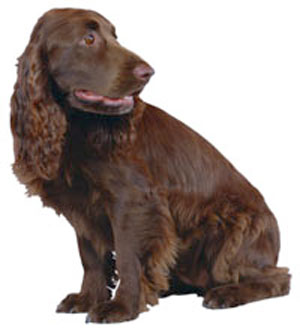
The Field Spaniel breed has a long, rich history, with roots in Spain and England, where the breed was developed into the vigorous and refined dog seen today. Like many modern-day Spaniels, the Field Spaniel is descended from the original old Spaniel types of England, whose heritages can be traced further back to the famous bird dogs of old from Spain known as the Épangeuls (the French word for Spaniel). Prior to the 1600s, Spaniels were all considered to be any dog that performed the function of flushing fowl into a net (prior to the invention of the gun) and then into the line of fire (after the invention of the gun). In 1882, the Kennel Club of England officially recognized the Spaniels in three varieties based on size and usage: the Field Spaniel, the Springer Spaniel, and the Cocker Spaniel. These dogs were divided according to size, and it was possible that each of the three varieties could occur in the same litter. While the English Springer and Cocker were left to the fields, ironically, the Field Spaniel was being bred almost exclusively for showing by the end of the 1800s. They bred in exaggerations and extremes meant to catch the judge’s eye, but those features became a hindrance in the field; therefore, the breed was rarely, if ever, used for the field again. A small interest in some hunting enthusiasts aimed to right the wrong of the field dog turned show dog sometime in the 1920s, but the breed never recovered, and the English Springer, Cocker, and Sussex remained the go-to breeds for hunting.
View Full Breed Standard
 Quick Facts

Group
Gun Dog Breeds

Life Expectancy
10 - 12 years

Coat Type
Medium-length with slight wave, Medium-length double coat

Origin
ENGLAND

Weight
40-55 lbs 35-45 lbs

Height
16-18 in 14-17 in
 Breed Ratings
How They Compare
Breed Ratings
How They Compare

Find Field Spaniel Puppies
Search our CKC registered breeders to find your new best friend!
 Breed History
Tails of Time
Breed History
Tails of Time
The Field Spaniel breed has a long, rich history, with roots in Spain and England, where the breed was developed into the vigorous and refined dog seen today. Like many modern-day Spaniels, the Field Spaniel is descended from the original old Spaniel types of England, whose heritages can be traced further back to the famous bird dogs of old from Spain known as the Épangeuls (the French word for Spaniel). Prior to the 1600s, Spaniels were all considered to be any dog that performed the function of flushing fowl into a net (prior to the invention of the gun) and then into the line of fire (after the invention of the gun). In 1882, the Kennel Club of England officially recognized the Spaniels in three varieties based on size and usage: the Field Spaniel, the Springer Spaniel, and the Cocker Spaniel. These dogs were divided according to size, and it was possible that each of the three varieties could occur in the same litter.
While the English Springer and Cocker were left to the fields, ironically, the Field Spaniel was being bred almost exclusively for showing by the end of the 1800s. They bred in exaggerations and extremes meant to catch the judge’s eye, but those features became a hindrance in the field; therefore, the breed was rarely, if ever, used for the field again. A small interest in some hunting enthusiasts aimed to right the wrong of the field dog turned show dog sometime in the 1920s, but the breed never recovered, and the English Springer, Cocker, and Sussex remained the go-to breeds for hunting.
 Breed Standard
Official CKC Standards
Breed Standard
Official CKC Standards
Field Spaniel
Breed Group 11: Gun Dog Breeds
Proportions:
Rectangular, with the length of the body measured from the point of the forechest to the point of the rump, being just slightly greater than the height at the withers. The length-to-height ratio is between 5:4 and 10:7. The body is well put together with sturdy substance and moderate yet sturdy bone. The weight of males or females is always in proportion to height.
Head
- General Appearance: Mesaticephalic skull type, moderate in size and in proportion to the rest of the body. The topskull is fairly broad and may be flat or just slightly arched on top. The face is well chiseled, with slightly raised brows. The occiput is well-defined. The head exhibits good bone and substance. The head is clean-cut and without excess skin or wrinkles.
- Expression: Alert, serious, noble, gentle, intelligent, and sociable.
- Stop: The stop is moderate, being neither steep nor shallow.
-
Skull:
The ideal muzzle-to-skull ratio is approximately 1:1, with the topskull being equal to the muzzle.
The ideal muzzle-to-skull axis is parallel. - Muzzle: The muzzle is full and deep yet long and somewhat lean. The muzzle should never appear square. The plane, or bridge of the muzzle, is straight. The upper and lower jaws are well developed, approximately equal in length, and have good bone substance, never appearing snipey or weak. The muzzle is powerful enough to sufficiently retrieve game all day long.
- Lips or Flews: The lips are clean and fit rather well over the teeth and jaws. The upper lip just covers the lower jaw but should not extend beyond the lower plane of the jaw. They are never loose, pendulous, or “wet.”
- Nose: The nose is well-pigmented, and liver. The nostrils are well-opened.
- Cheeks: The cheeks are well-developed and well-muscled. They should not appear chiseled or flat.
- Dentition and Bite: Forty-two strong, clean, and white teeth. The bite may be level, scissor, or reverse-scissor. Contact must be made between the top and bottom incisors. Missing or broken teeth due to routine work are not to be penalized.
- Eyes: Moderate in size, open-oval, or open-almond shape, and hazel, amber, or medium-brown in color. The eye rims are well-fitted and well-pigmented. The eyes are never bulging. There should be sufficient bone in the surrounding orbital sockets to protect the eyes. Any signs of entropion or ectropion are incorrect for this breed.
- Ears: Moderately long, fairly broad throughout, and set level somewhat low on the skull, with the base falling even with or slightly below the level of the eyes. The ears are drop and hang fairly close to the head.
Body and Tail
- General Description: Somewhat compact, deep, and of sufficient substance to allow for stamina, endurance, and agility. The body is never racy, refined, heavy, or cloddy. The width at the forequarters is approximately equal to the width at the hindquarters.
- Neck: Moderate length allows for good head carriage. It is strongly muscled with a slight arch. The neck tapers smoothly from the deeper and broader body toward the head. The neck is clean-cut and without excess skin, throatiness, or dewlap.
- Chest: Deep and broad but never wider than deep. The brisket extends to the point of the elbows.
- Topline: Level or just slightly sloped from slightly prominent withers to croup. The back is broad, strongly muscled, and straight, yet supple. The loin is taut, being flat and level or slightly arched, yet supportive. The back is never short, swayed, or roached.
- Croup: Broad and gently sloped.
- Underline: A slight to moderate tuck-up is present. The underline is taut and firm, without any indication of sagging or excess weight.
- Ribs: Long, well-sprung, well-laid-back, and oval-shaped, never barrel-chested or slab-sided.
- Tail: Set somewhat low on the croup. It is thick at the base and tapering toward the tip. The tail is carried in accordance with the dog’s mood and energy level, typically at approximately the level of the topline, but never tucked or carried up over the back. The tail may be left natural (preferred) or docked short. Natural tails are of a moderate length, with the tip of the last vertebrae extending to the hock joints when held down. The tail may be straight or gently curved. Docked tails are customarily surgically cut to 2/3rds of the original length.
Forequarters and Hindquarters
- Forequarters: The forequarters are always balanced with the hindquarters and well-angulated with well-laid-back shoulder blades. The shoulder blades are approximately equal in length to the upper arm and forearm.
- Elbows: The elbows are close to the body. The point of the elbow is approximately half the dog’s height at the withers.
-
Forelegs:
Frontal View: Straight, of good muscle, of sturdy (yet moderate) bone, and parallel to one another.
Side View: The forelimbs appear straight with strong pasterns. - Pasterns: Never weak or broken.
-
Hindquarters:
The upper and lower thighs are equal in length, strong, sturdy yet moderate bone, and well-muscled.
Rear View: When viewed from the rear, the rear pasterns are parallel to one another.
Side View: Good angulation will allow the rear toes to align with the point of the rump or within one to two paw-lengths behind the point of the rump, with the rear pasterns remaining perpendicular to the ground and parallel to one another. - Stifle Joint: Well-angulated with a good bend to well-let-down rear pasterns.
- Stifle Joint: The angulation of the hindquarters is always in balance with the angulation of the forequarters.
- Feet: Oval to round and compact, with well-arched toes and tough pads.
Coat
- Skin: Well-fitted, yet supple. The skin should never obstruct the outline of the dog.
- Coat Type: The single outer coat is short on the face, forehead, and front of the forelimbs, hindlimbs, fore and hind pasterns, and feet. It is medium-long in length on the body, with slightly longer furnishings on the ears, underline, chest, tail, and back of the forelegs and hind legs. It may be flat, wavy, never curly or wooly.
- Coat Color or Pattern: Solid black, liver, or liver-red with or without tan points, with or without clear white or roan chest marking; black (blue), liver, or liver-red roan with or without tan points.
Movement
The movement of the Field Spaniel breed is effortless, energetic, efficient, active, and merry. The characteristics of a healthy structure are evident. When moving away, the forelegs and rear pasterns should remain parallel to one another. When viewing movement from the front, the forelegs should remain parallel, with elbows and paws moving neither in nor out. From the rear, the back pads should be visible when the rear legs are extended. As speed increases, the forelimbs and hindlimbs will converge to the centerline of gravity. From the side, the topline should remain firm and level. Good reach of movement in the front allows the forepaw to extend out in line with the nose. When extended, the width between the forefeet should be approximately equal to the width between the hindfeet when extended, indicating balance, good reach, and good drive. Dogs that exhibit any sign of breathing or locomotive difficulty shall be disqualified from the show ring.
Temperament
The Field Spaniel breed is defined by their easy-going nature, unusually docile disposition, and enthusiasm for life. They are very people-oriented dogs, being friendly, intelligent, and sociable with other dogs and people. They are highly intelligent, taking on most training tasks with enthusiasm. They are happiest in a home that allows them ample room for running and plenty of mental and sensory exercise. Any unprovoked aggressive or fearful behavior toward people is incorrect for this breed.
Faults
All dogs should be in proper, healthy condition, free from disease or defect. Any departure from this description is considered a fault. Unless altered, all male dogs should have two fully descended testicles.

Take our Dog Breed Match Quiz!
What is the best dog breed for you? Take our quiz!