
meet the... English Shepherd
English Shepherds have been bred for generations as all-purpose working farm dogs. Their responsibilities have ranged from herding and protecting stock to dispatching vermin, guarding the home, and watching over children. The unique ability to handle all types of livestock and various tasks is this breed's defining feature. The English Shepherd is a dog of medium size, presenting a picture of sturdy balance and harmonious proportions. They are alert, and their face shows a high degree of intelligence. Since working and tending livestock are the primary functions of the English Shepherd, their physical makeup should enable them to fulfill those duties with maximum efficiency. Evaluation of type must be subordinated to an evaluation of soundness, character, and ability when determining the value of an English Shepherd.
View Full Breed Standard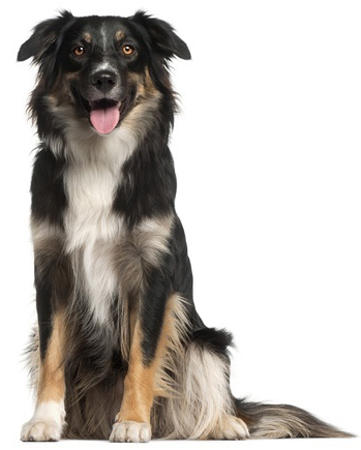
English Shepherds have been bred for generations as all-purpose working farm dogs. Their responsibilities have ranged from herding and protecting stock to dispatching vermin, guarding the home, and watching over children. The unique ability to handle all types of livestock and various tasks is this breed's defining feature. The English Shepherd is a dog of medium size, presenting a picture of sturdy balance and harmonious proportions. They are alert, and their face shows a high degree of intelligence. Since working and tending livestock are the primary functions of the English Shepherd, their physical makeup should enable them to fulfill those duties with maximum efficiency. Evaluation of type must be subordinated to an evaluation of soundness, character, and ability when determining the value of an English Shepherd.
View Full Breed Standard
 Quick Facts

Group
Pastoral and Stock Dog Breeds

Life Expectancy
12 - 15 years

Origin
UNITED STATES

Weight
50-65 lbs 40-55 lbs

Height
20-24 in 18-22 in
 Breed Ratings
How They Compare
Breed Ratings
How They Compare

Find English Shepherd Puppies
Search our CKC registered breeders to find your new best friend!
 Breed History
Tails of Time
Breed History
Tails of Time
English Shepherds have been bred for generations as all-purpose working farm dogs. Their responsibilities have ranged from herding and protecting stock to dispatching vermin, guarding the home, and watching over children. The unique ability to handle all types of livestock and various tasks is this breed's defining feature.
The English Shepherd is a dog of medium size, presenting a picture of sturdy balance and harmonious proportions. They are alert, and their face shows a high degree of intelligence. Since working and tending livestock are the primary functions of the English Shepherd, their physical makeup should enable them to fulfill those duties with maximum efficiency. Evaluation of type must be subordinated to an evaluation of soundness, character, and ability when determining the value of an English Shepherd.
 Breed Standard
Official CKC Standards
Breed Standard
Official CKC Standards
English Shepherd
Breed Group 10: Pastoral and Stock Dog Breeds
Breed Name Aliases
English Collie
Proportions:
The English Shepherd breed is a slightly square to somewhat rectangular dog breed, being slightly longer than tall. The distance from the point of the chest to the point of the rump is just slightly greater than the height at the withers, with a desired body height-to-length ratio being 5:4 to 10:9. The distance from the withers to the base of the tail is equal to the distance from the withers to the ground. The body is strongly built for agility and endurance, being medium in size, with moderate substance and medium bone. Well-balanced and muscular, yet never cloddy or light, the English Shepherd should never exhibit extremes of any sort, including extremes in mass, size, or coat. Males should appear masculine, being more substantial in size and mass, while females should appear more feminine and slightly less substantial. Neither should lack overall type. The weight of males or females is always in proportion to height.
Head
- General Appearance: Mesaticephalic skull type, moderate in size, wedge-shaped, and in proportion to the rest of the body. The top skull is slightly arched in profile or, when viewed from the front, may be slightly arched or flat. The occiput may be slightly prominent. The topskull length from the occiput to the stop is equal to the width from side to side, measured in front of the ears. In profile and from above, the head should form a wedge shape. The head is clean-cut and without excess skin or wrinkles.
- Expression: Alert, intelligent, watchful, keen, eager, and friendly.
- Stop: The stop is moderately defined.
-
Skull:
The ideal muzzle-to-skull ratio is 1:1, with the topskull being equal in length to the muzzle.
The ideal muzzle-to-skull axis may run parallel or be slightly convergent. - Muzzle: The muzzle is full, deep, and broad. Upper and lower jaws have good bone substance, appear strong and well-developed, and never appear snipey or weak. It should taper just a bit toward the nose, forming a blunt wedge.
- Lips or Flews: The lips are clean and fit tightly over the teeth and jaws.
- Nose: The nose is well-pigmented, black, or self-colored, according to the coat in non-standard color varieties. The nostrils are well-opened.
- Cheeks: Some padding of the cheek is present. The cheeks should not appear chiseled or coarse.
- Dentition and Bite: Forty-two strong, clean, and white teeth. The bite may be level or scissor. Contact must be made between the top and bottom incisors. Missing or broken teeth due to routine work are not to be penalized.
- Eyes: Medium in size, set well into the skull, almond or oval in shape, and slightly obliquely set. The eyes may be light brown to dark brown in color. Eyes rims are tightly fitted and well-pigmented. The eyes should never appear bulging or rounded.
- Ears: The ears are of moderate size, set fairly wide apart on the skull, and high on the head, with the inner corners being level with the plane of the topskull. They are triangular in shape with rounded tips. They may be naturally dropped or with some lift to the base, or they may be naturally rose. The ears should never be fully erect or houndy.
Body and Tail
- General Description: Compact, solid, and good substance. The body is never racy or refined. The width at the forequarters is approximately equal to the width at the hindquarters.
- Neck: Moderate length allows for a proud head carriage. Strongly muscled with a slight arch. The neck tapers smoothly from the deeper and broader body toward the head. The neck is clean-cut, without excess skin, throatiness, or dewlap.
- Chest: Deep and broad but never wider than deep. The brisket extends to the point of the elbows.
- Topline: Level from slightly prominent withers to croup. The back is broad, strongly muscled, and straight, yet supple. The loin is taut, level, or slightly arched, yet supportive. The topline is never swayed or roached.
- Croup: Gently sloped.
- Underline: A slight to moderate tuck-up may be present. The underline is taut and firm, without any indication of sagging or excess weight.
- Ribs: Long, well-sprung, well-laid-back, oval-shaped, never barrel-chested or slab-sided.
- Tail: Set neither high nor low on the croup. The tail is a natural extension of the dog’s topline. It is thick at the base and tapering toward the tip. Carried in accordance with the dog’s mood and energy level, usually in a natural, neutral position, but never tucked or carried up over the back. The tail may be a natural full-length tail or a natural bobbed tail, never docked short. Natural full-length tails are of a moderately long length, with the tip of the last vertebrae extending to the hock joints when held down. Natural tails are elegant and straight or may form a graceful curve. Natural bobtails may be any length as long as they are straight and without kinks.
Forequarters and Hindquarters
- Forequarters: The forequarters are always balanced with the hindquarters and well-angulated with well-laid-back shoulder blades. The shoulder blades are approximately equal in length to the upper arm and forearm.
- Elbows: The elbows are close to the body. The point of the elbows is approximately half the dog’s height at the withers.
-
Forelegs:
Frontal View: Straight, of good muscle and bone, and parallel to one another.
Side View: The forelimbs appear straight with strong pasterns. - Pasterns: Never weak or broken.
-
Hindquarters:
The upper and lower thighs are equal in length, strong, sturdy, of good bone, and well-muscled.
Rear View: When viewed from the rear, the rear pasterns are parallel to one another.
Side View: Good angulation will allow the rear toes to align with the point of the rump or within one paw-length behind the point of the rump, with the rear pasterns remaining perpendicular to the ground and parallel to one another. - Stifle Joint: Well-angulated with a good bend to well-let-down rear pasterns.
- Stifle Joint: The angulation of the hindquarters is always in balance with the angulation of the forequarters.
- Feet: Oval to round, compact, with well-arched toes and tough pads.
Coat
- Skin: Well-fitted, yet supple. The skin should never obstruct the outline of the dog.
- Coat Type: The outer coat is medium in texture and length and straight, wavy, or slightly curled. The coat is rugged and weather resistant. The undercoat is soft, and the density varies. The head, ears, front of legs, and lower hocks are short and close. The backside of the legs and breeches are moderately feathered with mane and frill. Individuals with a natural tail will have a richly plumed tail.
-
Coat Color or Pattern:
CKC recognizes two color varieties of the English Shepherd breed: the standard and nonstandard.
Standard coat color variety: Black and tan, tricolor, sable and white, black and white, clear sable, presenting in any shade of cream to red, or tan and white. Black masks are permissible. White markings are preferred in a symmetrical “Irish” pattern (with or without a full collar), including on the muzzle, and may extend as a blaze, on the neck, and may extend as a collar, on the underside, on the feet or legs, and the tip of the tail. White markings should not cover more than 30% of the dog’s body.
Nonstandard coat color variety: Solid black or solid white; piebald (more than 30% white markings), liver, blue or gray with or without tan, saddle, or white markings.
Movement
Effortless, efficient, energetic, indicative of great agility, power, and stamina, the characteristics of a healthy structure are evident. When moving away, the forelegs and rear pasterns should remain parallel to one another. When viewing movement from the front, the forelegs should remain parallel, with elbows and paws moving neither in nor out. From the rear, the back pads should be visible when the rear legs are extended. As speed increases, the forelimbs and hindlimbs will converge to the centerline of gravity. From the side, the topline should remain firm and level. Good reach of movement in the front allows the forepaw to extend out in line with the nose. When extended, the width between the forefeet should be approximately equal to the width between the hindfeet when extended, indicating balance, good reach, and good drive. Dogs that exhibit any sign of breathing or locomotive difficulty shall be disqualified from the show ring.
Temperament
The English Shepherd breed is a confident, energetic, and intelligent dog that loves a job. Their even disposition, good nature, can-do attitude, and devotion to their family make them great family pets. As with many herding dogs, their original purpose required them to have a sense of ownership and control for their flock or herd, which can carry over to other things, for example, their truck, their yard, their toys, and their family. Adult dogs are not expected to be overly friendly toward strangers; a healthy reserve or aloofness is not to be penalized. However, any unprovoked aggressive or fearful behavior toward people is incorrect for this breed.
Faults
All dogs should be in proper healthy condition, free from disease or defect. Any departure from this description is considered a fault. Unless altered, all male dogs should have two fully descended testicles.

Take our Dog Breed Match Quiz!
What is the best dog breed for you? Take our quiz!